Subscription Billing
Explore the top Chargebee alternatives for smarter billing, better pricing, and an ideal, flexible subscription management solution for your business.
Jump to Read:
What Is Chargebee and Why Consider its Alternatives?
12 Leading Chargebee Alternatives
Features to Look for in Chargebee Alternatives
Which Chargebee Alternative Should You Choose?
Find Your Perfect Billing Solution
FAQ
TL;DR:
Chargebee is one of the best-known billing platforms around, but it isn't the right fit for every business. This guide compares 12 alternatives for B2B SaaS and subscription companies, weighing their options in 2026, from lightweight tools to enterprise-grade platforms. Leading the list is Younium, a subscription management and billing platform built for B2B SaaS – with multi-entity structures, layered contracts, native CPQ, and revenue recognition for IFRS 15 and ASC 606.
Chargebee is one of the best-known billing platforms around, but it isn't the right fit for every business. This guide compares 12 alternatives for B2B SaaS and subscription companies, weighing their options in 2026, from lightweight tools to enterprise-grade platforms. Leading the list is Younium, a subscription management and billing platform built for B2B SaaS – with multi-entity structures, layered contracts, native CPQ, and revenue recognition for IFRS 15 and ASC 606.
Chargebee alternatives fall into two main groups: subscription billing and revenue platforms that plug into your existing payment gateways, and Merchants of Record that take on tax and compliance liability as the legal seller. The right choice depends on how you sell, where you sell, and how your finance team needs the numbers to land. For B2B SaaS with multi-entity structures and IFRS 15 / ASC 606 revenue recognition, billing platforms like Younium, Maxio, and Zuora are the closest fit; for global tax-burden offload, Paddle and FastSpring lead the Merchant-of-Record category.
The platform that's right at 200 customers isn't always the one that's right at 2,000 – not because it breaks, but because what you need from it gets more specific. Percentage-based fees start eating into margin as volume climbs. You need finance-grade revenue recognition across ramped or multi-entity deals, a merchant of record to take on tax liability, or an open-source platform you can fully control. The tool that nails one of those rarely nails the rest.
This isn't about Chargebee being a bad product – it's a capable, SaaS-focused platform. It's that no single tool suits every business model, and the right call comes down to your specifics.
The 12 alternatives below are compared on the factors that actually decide a switch: pricing clarity, billing flexibility, revenue recognition, and business-model fit. First, a quick look at what Chargebee does well – and where teams start shopping around.
What Is Chargebee and Why Consider its Alternatives?
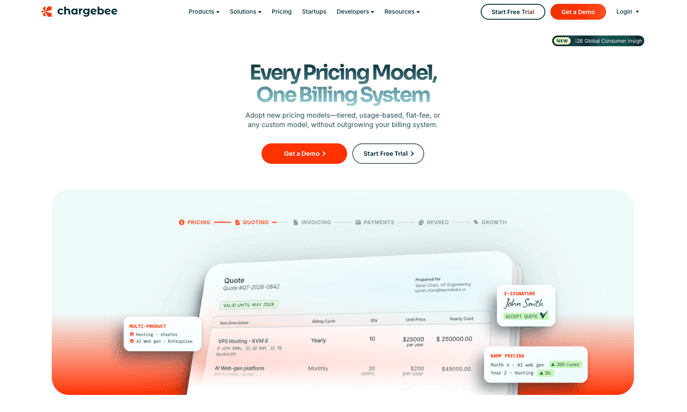
Image via Chargebee
Chargebee is a cloud-based subscription management and billing platform built primarily for SaaS, software, and AI companies, though it also serves ecommerce and media businesses.
It automates recurring billing, invoicing, revenue recognition, and customer lifecycle operations, supporting flat-rate, tiered, and usage-based pricing, with built-in RevenueStory analytics that surface metrics like MRR, ARR, and churn. It scales from self-serve signups to sales-led, contract-based deals.
The questions tend to start later, once a company's billing gets more demanding than the tool was built for. Here's where teams most often run into the edges:
|
Where teams hit a wall |
What's going on |
|
Cost at scale |
Percentage-based fees and revenue caps climb with volume, so the bill can grow faster than the value. (Chargebee's pricing model is worth reading closely before you commit.) |
|
Customization limits |
Dynamic workflows and unusual billing setups can run into a fairly rigid structure. |
|
Setup effort |
A steep learning curve and patchy implementation support can drag onboarding out longer than planned. |
|
B2B SaaS gaps |
Chargebee supports ASC 606 and IFRS 15 revenue recognition, but newer constructs like subscription ramps don't yet flow fully into its RevRec and RevenueStory reporting. Finance teams running heavily ramped or usage-based contracts may want deeper, purpose-built revenue recognition. |
|
Integrations |
Some teams need broader connectivity or a more flexible API than the native options cover. |
|
Chargebacks & gateways |
Full chargeback workflows only cover select vendors; everyone else manages disputes by hand, and taxes and gateways need manual setup. |
|
Tax & region |
Chargebee isn't a merchant of record, so VAT, GST, and regional tax handling sit with you. |
Chargebee is still a solid baseline for subscription management and revenue ops. It's just that a baseline has a ceiling. Teams start shopping around once cost, flexibility, or scale stop matching where the business is heading.
Also Read:
- What is SaaS Billing? Best Practices and How-To Guide
- What is Subscription Billing? A Guide for SaaS Businesses
12 Leading Chargebee Alternatives
There are numerous powerful Chargebee alternatives that can help you manage your subscription operations. Each platform brings unique strengths that could better align with your business requirements. Let’s dive in.
1. Younium
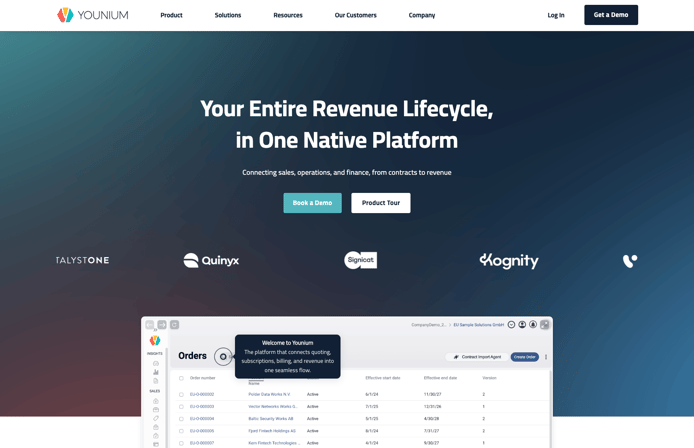
Image via Younium
Younium is a subscription management and billing platform built for B2B SaaS companies that have outgrown general-purpose tools – the ones juggling multi-entity structures, layered contracts, and revenue recognition that their auditors will actually sign off on.
Its strength shows up after the contract is signed. When a customer upgrades, downgrades, or changes terms mid-cycle, Younium recalculates the price and rebuilds the revenue schedule on its own, keeping the full version history for audit. That's the part finance teams usually stitch together by hand.
The numbers back it up: Voyado cut billing lead times by 93% after switching, and proptech firm iBinder trimmed 50% off its admin work while scaling across five countries. As Formpipe's CFO, Joakim Alfredson put it, "...with Younium, we work with a vendor that really partners with us."
Key Features
- Multi-entity and multi-currency billing with consolidated financials for global reporting.
- Flat, tiered, volume, milestone, and usage-based pricing with flexible billing schedules and discount logic.
- Automated recurring and usage-based billing with built-in tax handling, credit notes, and dunning.
- Revenue recognition for IFRS 15 and ASC 606, with rule-based schedules, segmented journals, and full audit trails.
- Real-time SaaS metrics (MRR, ARR, churn, ACV) on customizable dashboards, plus AI Agents and an MCP endpoint that opens Younium's data to any LLM.
- Native CRM and ERP integrations plus an open REST API across the quote-to-cash flow.
- Less revenue leakage from automated invoicing, missed-renewal alerts, and usage tracking.
- One system for product-led, sales-led, or hybrid growth motions.
G2 Rating: 4.2/5
Best for: B2B SaaS companies with multi-entity setups, layered contracts, and finance-grade revenue recognition needs – typically mid-market to enterprise.
Keep in mind: Younium is built for depth, and that comes with a learning curve – the main thing to get used to is the range of subscription and data options. If your billing is simple, flat-rate, or B2C, it's more than you need. For B2B teams with layered contracts and multiple entities, that depth is the point – and setup runs as guided onboarding with Younium's team, not a solo config job.
Pricing
Younium uses contact-us pricing, tied mainly to the recurring revenue it manages for you, plus the number of legal entities and connectors you need. Every customer starts on Younium Core. Book a demo for a tailored quote.
Also Read:
- Best Revenue Recognition Software (Plus How to Choose the Best One)
- Top Subscription Billing Platforms
2. Stripe Billing & Revenue Recognition
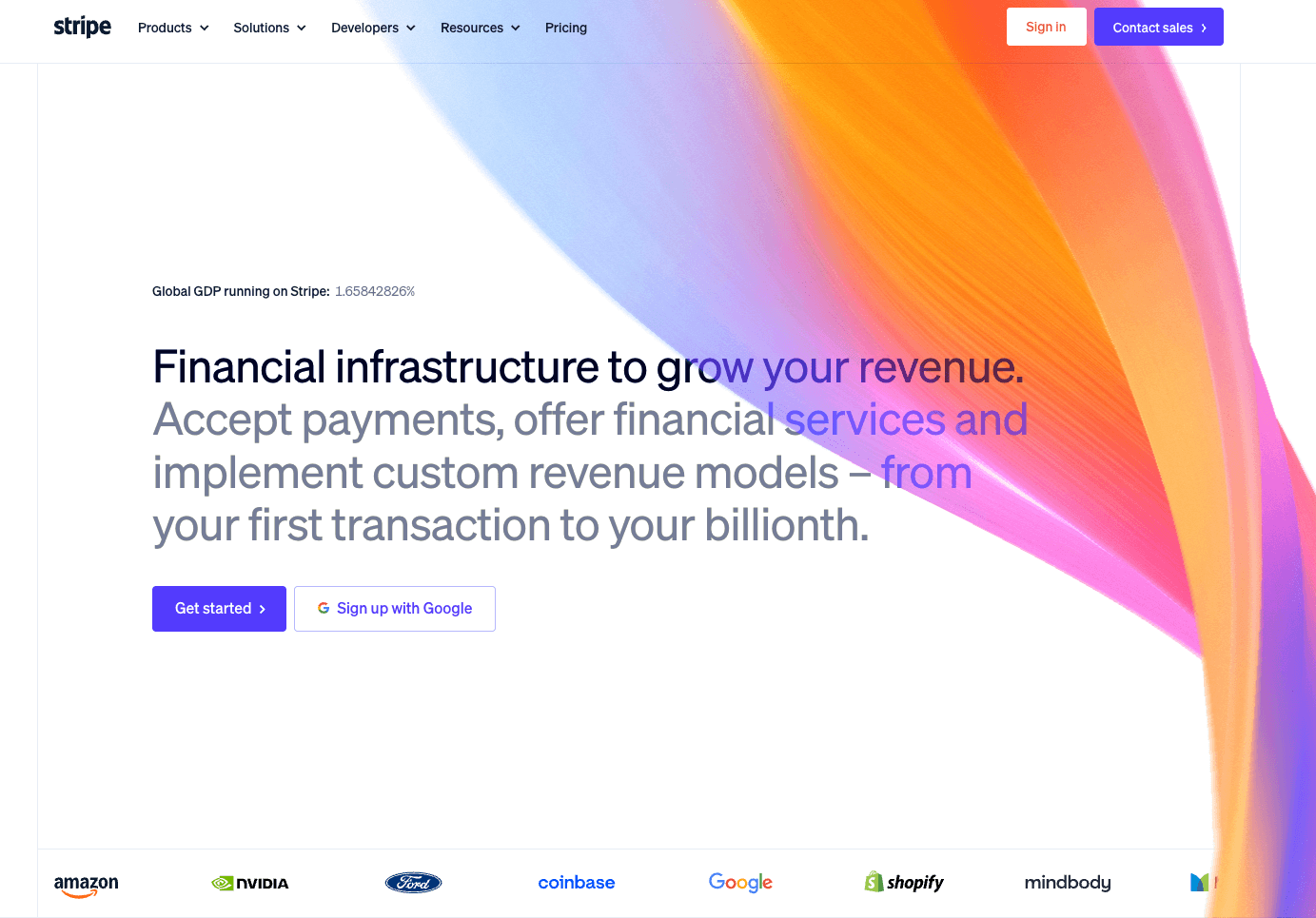
Stripe Billing is the subscription and invoicing layer that sits on top of Stripe's payments, with Stripe Revenue Recognition as a separate add-on for ASC 606 and IFRS 15 reporting. If you're already on Stripe, switching these on is the low-friction option – recurring charges, invoices, and rev rec all read from data you're already collecting.
It's developer-first and built for straightforward billing, so it suits self-serve and smaller teams. The gap is B2B depth: multi-entity reporting, layered contracts, and mid-term proration aren't its strong suit, and rev rec is a bolt-on rather than the core.
Staying inside the Stripe family feels like the obvious move if you're already there, but the upside is thinner than it looks. Most serious revenue platforms, Younium included, already plug into Stripe for payments – so you can let Stripe do what it's great at and run billing and rev rec on a finance-first system instead.
Key Features
- Flat, tiered, volume, usage-based, and hybrid pricing with proration, trials, and scheduling.
- Smart dunning with retries and hosted recovery pages for failed payments.
- Invoicing with custom templates, credit notes, and a virtual terminal.
- Revenue recognition for ASC 606 and IFRS 15, with audit traceability (separate add-on).
- Connects with NetSuite, QuickBooks, and Xero, plus webhooks.
G2 Rating: 4.4/5 for Stripe Billing; 3.8/5 for the Revenue Recognition add-on.
Best for: Teams already on Stripe who want billing and rev rec in the same place – usually self-serve or developer-led rather than B2B finance operations.
Keep in mind: The most common gripe is cost – transaction fees and extra charges stacking up as you scale. The Revenue Recognition add-on draws a separate, repeated note: setup takes real effort and assumes some accounting knowledge.
Pricing
- Payments: 2.9% + $0.30 per successful domestic card transaction
- Billing adds a percentage of billing volume on top
- Revenue Recognition is a separate add-on, custom for larger volumes
3. Recurly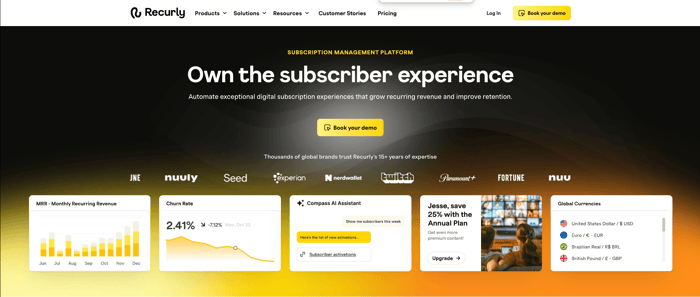
Recurly is a subscription billing platform with a clear focus: keeping revenue from leaking out through failed payments and churn. Where Recurly concentrates is failed-payment recovery – dunning, smart retries, and payment routing – which is why it tends to land with B2C and subscription brands in media, streaming, and ecommerce rather than B2B finance teams.
For B2B finance teams, the fit is looser. Recurly handles fixed, tiered, usage-based, and hybrid pricing well enough, but it's built around recovering recurring payments rather than the contract depth a complex B2B book needs – multi-entity consolidation, layered terms, and finance-grade revenue recognition aren't where it's strongest.
Key Features
- Automated dunning with retry schedules, pause/cancel logic, and customer segmentation.
- Fixed, tiered, volume, usage-based, ramp, and one-time charges, combinable in one plan.
- Backup payment methods, expired-card auto-updates, and smart retries to recover failed payments.
- Multi-gateway payment processing with dynamic routing per region.
- Subscriber analytics, churn tracking, and dunning performance dashboards.
G2 Rating: 4/5
Best for: B2C and subscription brands – media, streaming, ecommerce – that want strong churn and failed-payment recovery without heavy developer work.
Keep in mind: The recurring sticking points are reporting and customization – limited reporting depth, workflows that need technical know-how to adjust, and billing configuration that some users find fiddly. For finance teams that live in their reports, that's worth testing before you commit.
Pricing
Recurly's entry tier is Starter, at $249/month plus 0.9% of billing volume, with the first $40k of volume free. Its high-volume All-Access plan is quote-only, priced on Total Payment Volume ($1M TPV minimum) with rates dropping under 1%, and an All-Access for Shopify plan covers ecommerce. Revenue Recognition is a separate add-on from around $850/month. A free sandbox is available to test it.
Also Read:
- The Most Important Subscription Management Software Features
- Best SaaS Reporting Tools (Plus How to Choose One)
4. Sage Intacct
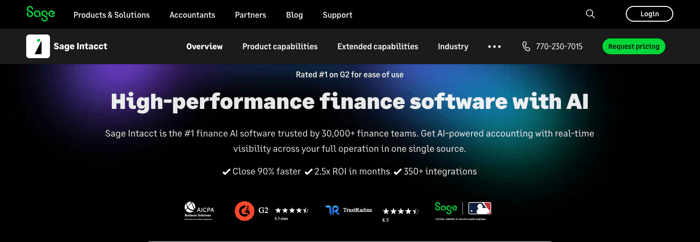
Sage Intacct is a cloud financial management system – closer to a full accounting backbone than a standalone billing tool. Its subscription and contract billing module covers recurring, usage-based, tiered, and milestone billing across 500+ scenarios, with revenue recognition for ASC 606 and IFRS 15 built in. Finance teams in professional services and nonprofits tend to like it, largely because billing lives in the same system as the rest of their books, alongside multi-entity consolidation and real-time SaaS metrics.
A lot of its strength is tied to Salesforce: customer and contract data flows both ways, so a deal closed in Salesforce lands in Sage Intacct ready to bill and recognize. That's genuinely useful if Salesforce is your CRM and you want finance running in one suite – but it's a much broader system to take on than a focused subscription layer, and a good chunk of the value depends on that Salesforce setup being in place.
Key features
- Recurring, usage-based, tiered, and milestone billing across 500+ subscription scenarios.
- Revenue recognition for ASC 606 and IFRS 15, with templates and schedules per subscription type.
- Bidirectional Salesforce integration – contracts entered in Salesforce sync to financials in real time.
- Multi-entity and multi-currency consolidation with base and transaction currencies.
- Termed and evergreen contracts with renewals, upgrades, cancellations, and mid-contract changes.
- Multi-dimensional dashboards and SaaS Intelligence for revenue and profitability by contract, product, or division.
G2 Rating: 4.3/5
Best for: Finance teams – especially in professional services and nonprofits – that want subscription billing and revenue recognition inside a full cloud accounting system, particularly if they already run on Salesforce.
Keep in mind: The main hurdle is the learning curve – it's a deep, feature-rich system that takes time and guidance to get properly comfortable with, and there are some gaps in reporting and customisation. For a team that only needs subscription billing and rev rec, that's a lot of system to adopt.
Pricing
Sage Intacct uses custom, quote-based pricing that scales with the modules, users, and complexity you need. There's no public price list.
5. Zoho Billing
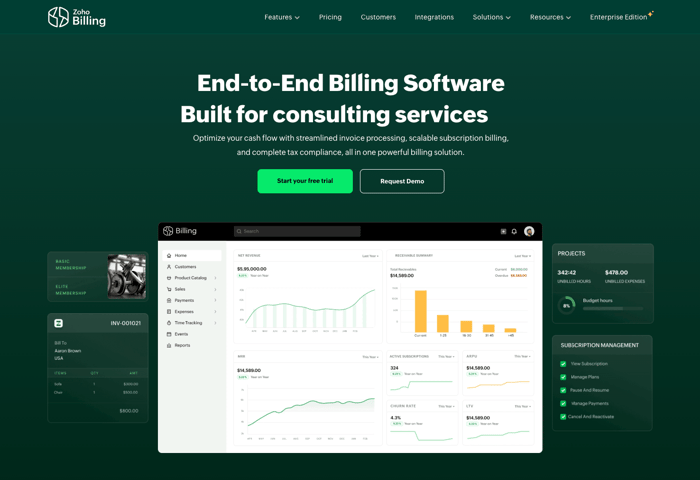
Zoho Billing is the billing and subscription arm of the wider Zoho suite, and that's the lens to view it through. On its own, it handles the full job – recurring and usage-based billing, invoicing with multi-currency and tax, quotes, trials, dunning, a customer portal, and 50+ reports including MRR and churn. Where it really pays off is when it's wired into the rest of Zoho: Books for accounting, CRM for sales, Analytics for reporting, all sharing the same data.
If you're already a Zoho shop, Zoho Billing is an easy add inside a suite you already run, but that value depends on buying into the wider Zoho stack, and for layered B2B contracts at scale the platform can feel stretched.
Key features
- Flat, tiered, volume, and usage-based pricing, with price lists and coupon/discount rules.
- Recurring billing on monthly, yearly, or custom cycles, plus metered billing.
- Invoicing with multi-currency, multilingual, and tax handling, plus expense and project billing.
- Subscription lifecycle management – pause, cancel, reactivate, upgrade, or downgrade mid-cycle.
- Dunning with retries, reminders, and card-expiry alerts across 10+ payment gateways.
- 50+ reports and subscription metrics, plus deep integration with Zoho Books, CRM, and Analytics.
- GDPR, PCI-DSS Level 1, and HIPAA support with role-based access.
G2 Rating: 4.4/5
Best for: SMBs already in – or happy to adopt – the Zoho ecosystem, who want affordable, unified billing, invoicing, and finance in one place.
Keep in mind: It's rated as strong value, but the catch is that a lot of that value depends on buying into the wider Zoho suite – and there are notes of slower performance with larger data sets and more complex subscription workflows. For a finance team running layered B2B contracts at scale, that's the bit to test first.
Pricing
Zoho Billing has two published tiers plus a custom one, with a 14-day free trial and no free plan:
- Standard – $25/organisation/month billed annually ($29 if paid monthly)
- Premium – $59/organisation/month billed annually ($69 if paid monthly)
- Enterprise Edition – custom pricing
Also Read:
6. Paddle
Paddle is a Merchant of Record (MoR) platform built specifically for SaaS and digital products. This means that Paddle becomes the legal seller of your product, taking on sales tax and VAT registration, filing, and remittance across more than 100 jurisdictions. Recurring billing, localised checkout, fraud protection, and churn recovery (through its Retain and ProfitWell Metrics tools) all sit inside the same managed service.
For a SaaS, app, or digital-product business selling globally without a tax team, Paddle takes the tax burden off the plate, but only within self-serve digital sales, not the layered contracts, multi-entity finance, and rev-rec depth that a complex B2B operation runs on. The trade-off is scope: Paddle is built around self-serve digital sales, not the layered contracts, multi-entity finance, and rev-rec depth a complex B2B operation needs – and the all-in 5% is more than you'd pay for plain payment processing, because you're also buying the compliance burden off your plate.
Key features
- Merchant of Record handling global sales tax and VAT registration, filing, and remittance.
- Localised checkout in multiple currencies and languages, embedded or overlay.
- Subscription billing with multi-product plans, add-ons, and coupons.
- Failed-payment recovery and churn reduction through Retain.
- Free real-time subscription analytics via ProfitWell Metrics.
- Fraud and chargeback protection, with SOC 2 and GDPR coverage.
G2 Rating: 4.5/5
Best for: SaaS, app, and digital-product companies selling globally that want tax and compliance handled for them – rather than B2B finance teams with complex contracts.
Keep in mind: The most common friction points are support response times, plus onboarding and billing-approval requirements that can feel strict or unclear during setup – a by-product of Paddle acting as the seller of record and vetting accounts before you go live.
Pricing
- Pay-as-you-go: 5% + 50¢ per checkout transaction, with tax, compliance, and support included
- Custom pricing for larger businesses, products under $10, or invoicing-based billing
Also Read:
- What is SaaS Analytics and Which Metrics Should You Track?
- Top Accounts Receivable (AR) Software Solutions
7. Orb
Orb is a usage-based billing platform built for the metered, consumption-style pricing that modern SaaS, cloud-infrastructure, and AI companies run on – think API calls, tokens, seats, or bandwidth turned straight into invoices. Raw usage events feed directly into pricing, so product and engineering teams can launch and change usage-based plans without rebuilding billing logic each time.
It's not only a metering tool anymore, though. Orb has added finance workflows – AR, dunning, and revenue recognition aligned to ASC 606 – plus connections into ERPs, so finance teams get audit trails and a faster month-end close alongside the usage data. Its sweet spot is still consumption-first models; if your billing is mostly seat- or contract-based across multiple entities, a broader subscription platform like Younium tends to fit the shape better.
Key features
- Usage metering with timestamped events, backdating, and backfilling for accuracy.
- No-code price modelling for usage, hybrid, and tiered plans, plus price simulations.
- Revenue recognition aligned to ASC 606, with AR and dunning in its finance workflows.
- Granular, real-time invoicing with usage breakdowns and spend alerts.
- Integrations with ERPs, data warehouses, CRMs, and tax engines.
G2 Rating: 5/5 (only a handful of reviews so far)
Best for: SaaS, cloud-infrastructure, and AI companies whose pricing is genuinely usage- or consumption-based and changes often.
Keep in mind: Orb has only a few public reviews so far, so there's not much peer feedback to go on yet. Where a downside comes up, it's the initial setup leaning technical – no surprise for a tool built to wire straight into product usage data. Orb is now part of Adyen (acquired 2026), so factor in how that ownership may steer its roadmap and pricing.
Pricing
Orb uses custom, quote-based pricing. Contact sales for a quote.
8. BillingPlatform
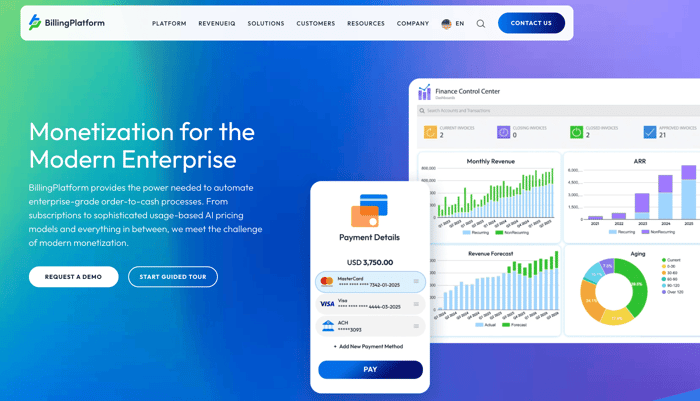
BillingPlatform is a revenue-lifecycle platform built to automate order-to-cash for large organisations with genuinely complicated billing – telecom, financial services, transportation, healthcare – handling subscription, usage, hybrid, and even formula-based pricing in one system. It's built for large enterprises with high-volume, multi-model billing across complex industries – the enterprise end of this list, where a mid-market finance team gets more platform than the job needs, and where Younium delivers finance-grade rev-rec without an enterprise rollout.
The draw is how far you can bend it. A no-code, point-and-click data model lets teams configure almost any billing logic, rev rec (ASC 606 and IFRS 15, with SSP determination and waterfall reporting), collections, and AR automation without custom code. The flip side is that all that configurability is a project in itself – this is a platform you implement and shape, not one you switch on, and it's built for enterprise scale rather than a lean finance team.
Key Features
- Subscription, usage, hybrid, and formula-based (Excel-style) pricing in one platform.
- No-code extensible data model with point-and-click configuration.
- Revenue recognition for ASC 606 and IFRS 15, with SSP determination and waterfall reporting.
- AR automation, collections, dunning, e-invoicing, and a customer portal.
- RevenueIQ AI tools for reporting, predictive insights, and admin.
- Integrations with NetSuite, Salesforce, Avalara, and more.
G2 Rating: 4.8/5 (only a handful of reviews so far)
Best for: Large enterprises with high-volume, multi-model billing across complex industries – and the resources to configure and run a platform of this depth.
Keep in mind: It's a big, highly configurable system, and that shows up at setup – the main downside raised is that implementation and configuration cycles run slow and technical, especially in test environments. For a mid-market team that wants finance-grade billing without an enterprise rollout, it can be more platform than the job needs.
Pricing
BillingPlatform doesn't publish pricing. It's fully custom and quote-only, scaled to your transaction volume and the modules you use – and priced for the enterprise. Contact sales for a quote.
Also Read:
9. Agentforce Revenue Management
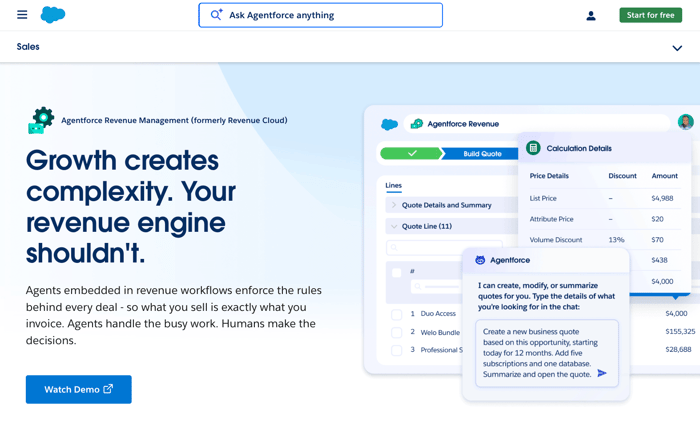
Agentforce Revenue Management – formerly Salesforce Revenue Cloud – runs quoting, pricing, contracts, ordering, and billing on top of the Salesforce platform, with AI agents handling routine steps along the way. It pulls the whole product-to-cash flow onto your CRM: CPQ and a product configurator, contract lifecycle management, order orchestration, subscription and asset management, and revenue analytics covering MRR, ARR, and billing.
For a company already standardized on Salesforce, that single-platform pull is the appeal – sales, finance, and legal working off one source of truth. The trade-off is that it's deeply tied to Salesforce and built for that level of scale. It's not something a finance team configures alone; the work usually runs through a Salesforce implementation partner, and that dependency shapes both the timeline and the cost.
Key Features
- CPQ with guided quoting, a unified product catalogue, and a rules-based configurator.
- Contract lifecycle management with redlining, clause libraries, and e-signature.
- Order orchestration and asset lifecycle management (amend, renew, cancel).
- Subscription management with real-time MRR and ARR visibility.
- Revenue, pricing, billing, and order analytics built on the platform.
- AI agents (Agentforce) embedded across the revenue workflow.
G2 Rating: 4.2/5
Best for: Enterprises already running on Salesforce that want quote-to-cash unified inside their CRM, with the admin resources to support it.
Keep in mind: With over 1,500 reviews, the most consistent theme is complexity – a steep learning curve and setup that needs niche Salesforce admin skills, often with external help to configure properly. Plan for an implementation project rather than a quick rollout.
Pricing
A paid add-on to Sales Cloud, billed annually per user:
- Revenue Cloud Growth – $150/user/month (CPQ and subscription management)
- Revenue Cloud Advanced – $200/user/month (adds contracts, consumption and invoicing, AI and analytics)
Also Read:
- Easy Steps to Improve Subscription Renewal Rates
- How Efficient Subscription Management enables accurate Revenue Forecasting
10. DealHub
DealHub is a quote-to-revenue platform built around CPQ – configuring quotes, automating approvals, and moving deals through to signature and subscription. Its DealRoom (a shared space for buyer and seller) and guided-selling tools are the standouts, and it plugs tightly into Salesforce, HubSpot, and Microsoft Dynamics. For sales and RevOps teams drowning in manual quoting, DealHub speeds the quote-to-signature path – but it's sales-led, not finance-led, so once your model reaches tiered usage, several legal entities, or custom revenue rules, a finance-first platform like Younium takes over.
The lens to keep, though, is that DealHub is sales-led, not finance-led. CPQ, contracts, and the deal flow are where it's strong; billing and subscriptions are there, but it doesn't do finance-grade revenue recognition or multi-entity consolidation. So once your model gets into tiered usage, several legal entities, or custom revenue rules, you're past what DealHub is built for – and a finance-first platform takes over from there.
Key Features
- AI-assisted CPQ with guided selling, dynamic bundles, and automated approval workflows.
- DealRoom – a shared digital space for proposals and buyer collaboration.
- Contract lifecycle management with document generation and e-signature.
- Subscription and recurring billing tied to the quote.
- No-code configuration, so admins adjust pricing logic without engineering.
- CRM and ERP integrations (Salesforce, HubSpot, Dynamics, NetSuite) with SOC 1/2 and ISO certifications.
G2 Rating: 4.7/5
Best for: Sales and RevOps teams that want to speed up quoting, approvals, and contracts inside their CRM – rather than finance teams needing deep revenue automation.
Keep in mind: The main sticking point is a steep learning curve early on, plus limited customisation for some customer-facing elements like email templates. Once teams are past the initial setup, satisfaction is high – but budget for that ramp.
Pricing
DealHub doesn't publish pricing. It's quote-only, scaled to the modules you need (CPQ, CLM, subscriptions/billing). Contact sales for a quote.
Also Read:
- The Pitfalls of Revenue Recognition in Spreadsheets
- How B2B SaaS Finance Teams Can Use Technology to Their Advantage
11. Zenskar
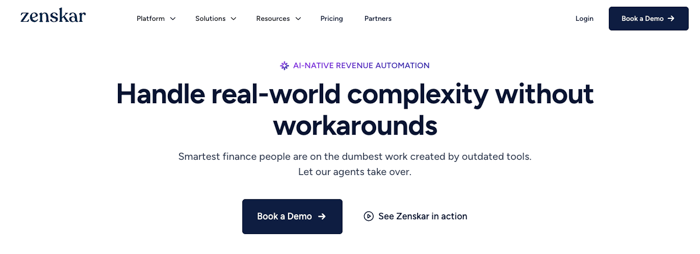
Zenskar is an AI-native billing and revenue-recognition platform aimed at finance teams with messy, real-world pricing that off-the-shelf tools force into workarounds. Its pitch is "agents execute, humans supervise" – AI handles the grunt work of invoicing, metering, and rev rec, while your team approves the results. It leans hard into usage-based and hybrid models, with a no-code pricing setup so finance can build and change plans without engineering.
It does cover the finance essentials properly: ASC 606 / IFRS 15 rev rec with SSP and performance-obligation handling, multi-entity and multi-currency consolidation, journal entries synced to your ERP, and SaaS metrics like MRR and ARR. It's a younger platform than most here, so the review base is smaller, and it competes closest with Younium on usage-based and hybrid B2B billing.
Key Features
- AI-native billing for subscription, usage, and hybrid pricing, configured no-code.
- Revenue recognition for ASC 606 and IFRS 15, with SSP, performance obligations, and ERP-synced journals.
- Usage metering and prepaid/postpaid credit handling without developers.
- Multi-entity, multi-currency consolidation across customer hierarchies.
- Real-time SaaS analytics – MRR, ARR, LTV, revenue waterfall.
- 100+ integrations across CRMs, ERPs, warehouses, and tax tools, plus Slack and MCP (Claude, ChatGPT).
G2 Rating: 4.8/5
Best for: Finance and RevOps teams at usage-based or hybrid SaaS companies who want billing and rev rec automated without building in-house workarounds.
Keep in mind: The downsides flagged are mild – the main one is occasional minor bugs, which reviewers note support fixes quickly, along with some gaps in reporting and dashboard depth, and a short learning curve at the start.
Pricing
Zenskar uses custom, quote-based pricing across its tiers, with a sandbox to test before you commit. Contact sales for a quote.
12. Lago
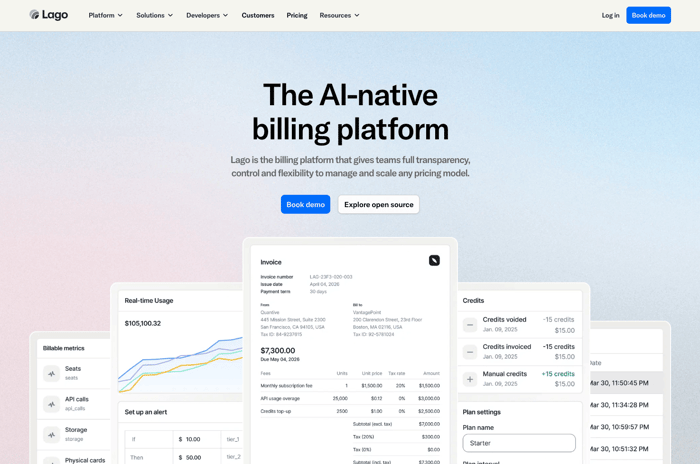
Lago is the open-source option on this list, built for usage-based and hybrid billing with full transparency over the billing engine. Instead of a black-box vendor, you get the actual code – deploy it self-hosted on your own infrastructure or use Lago's cloud, and audit every line if you need to. That openness appeals to engineering-led teams willing to run their own billing stack - but self-hosting and integration are an engineering job, not a finance-team setup, which is the trade-off for the control it offers.
It's event-driven and developer-first at heart, with real-time usage metering, hybrid pricing, prepaid credits, invoicing, dunning, and revenue analytics, and it's payment-agnostic, so you keep your own processor. The appeal is control and no vendor lock-in; the trade-off is that you bring the technical resources. Self-hosting and integration are an engineering job, not a finance-team setup – which is the right call for some teams and a dealbreaker for others.
Key Features
- Real-time, event-based usage metering for usage and hybrid pricing.
- Open-source core with self-hosted or cloud deployment, and no vendor lock-in.
- Invoicing, prepaid credits/wallets, coupons, and entitlements.
- Cash collection and dunning, payment-agnostic across providers.
- Revenue analytics across every stream.
- Integrations with Stripe, Adyen, NetSuite, Xero, Salesforce, and tax tools, with SOC 2 Type II.
G2 Rating: 5/5 (only one review so far – see note below)
Best for: Engineering-led teams that want full control over their billing stack, no vendor lock-in, and the option to self-host – typically usage-based SaaS, AI, and infrastructure companies.
Keep in mind: Lago needs more technical input than a plug-and-play tool. The flexibility is the point, but expect a learning curve moving over from Stripe Billing or Chargebee, and budget for careful integration.
Pricing
- Open-source (self-hosted): free.
- Cloud and Premium: custom, quote-based – contact sales.
Features to Look for in Chargebee Alternatives
With all these options, certain features can make or break your subscription billing success. The right platform should handle your current needs while scaling with your business growth.
Here’s what to prioritize:
Flexible Pricing Models
Your billing platform should support multiple pricing structures without forcing you into rigid templates. Look for ones that handle flat-rate, tiered, volume-based, and usage-based pricing models seamlessly. The best choices also support hybrid approaches, combining recurring subscriptions with one-time charges.
Modern businesses often need milestone-based billing for professional services, smart proration, or custom implementation fees. Your chosen platform should accommodate these scenarios without requiring workarounds. Tools like Younium make it easier to test and refine pricing models as your revenue strategy evolves.
Automated Revenue Recognition
Revenue recognition compliance isn’t optional for growing businesses. Ensure the provider has automated ASC 606 and IFRS 15 compliance features. This automation reduces manual work for finance teams while ensuring accurate financial reporting.
Look for platforms that automatically calculate deferred revenue schedules based on service periods. Audit-ready journal entries and real-time revenue recognition updates help you maintain accurate books without waiting for month-end processes. Younium, for example, handles this natively, keeping finance teams aligned and audit-ready at scale.
Comprehensive Integration Capabilities
Your billing platform shouldn’t exist in isolation, so look for an alternative that integrates well with your existing CRM, ERP, and accounting systems. This connectivity eliminates data silos and reduces manual data entry errors.
Payment gateway integrations are equally important, and ideally, the platform would support multiple payment processors to give customers flexibility. Integration with tax calculation services helps handle complex global tax requirements automatically.
Also Read:
- The Future of SaaS Pricing: Finding the Right Model for Growth
- SaaS Revenue Recognition: Scenarios, Standards, and Methods
Advanced Analytics and Reporting
Prioritize platforms offering real-time subscription metrics like MRR, ARR, and churn rates. Cohort analysis helps you understand customer behavior patterns over time.
The best platforms provide customizable dashboards so different teams can access relevant metrics. Finance teams need revenue recognition reports, while sales teams want pipeline and conversion data. Built-in forecasting helps predict future revenue based on current trends.
AI-Powered Insights
Artificial intelligence (AI) is transforming subscription management by providing actionable insights from your billing data. Modern billing and revenue management platforms incorporate AI to predict customer churn, identify upselling opportunities, and optimize pricing strategies. These capabilities help you stay ahead of potential issues.
AI-powered natural language queries let you ask questions about your data without complex dashboard navigation. This conversational approach makes insights accessible to non-technical team members. Machine learning algorithms can also detect unusual billing patterns that might indicate fraud or errors.
Scalable Architecture
Your billing platform should grow with your business without requiring expensive migrations. Look for alternatives built on modern, scalable architectures that handle increasing transaction volumes smoothly. Cloud-based solutions typically offer better scalability than on-premise alternatives.
Consider platforms that support multiple currencies and international tax requirements if you’re planning global expansion. An ideal alternative should also manage VAT, GST, and multi-entity support for consolidated reporting. The ability to handle complex billing scenarios today prevents costly platform switches tomorrow.
Also Read:
- Essential Subscription Revenue Recognition Strategies
- Strategies to Improve Your Customer Retention Rate
Which Chargebee Alternative Should You Choose?
- Multi-entity B2B billing with revenue recognition: Younium – built for multi-tier contract structures, IFRS 15 / ASC 606, and parent–subsidiary hierarchies.
- Global tax compliance as a Merchant of Record: Paddle – handles VAT and GST across 100+ jurisdictions.
- Developer-first, API-led billing: Stripe Billing or Orb – ideal for engineering teams building custom billing logic.
- Churn recovery and failed-payment management: Recurly – smart dunning workflows.
- Open-source billing control: Lago – self-hosted, transparent, free to start.
Find Your Perfect Billing Solution
From enterprise-grade platforms to lightweight, developer-friendly tools, today’s Chargebee alternatives cater to every stage of SaaS growth.
Whether you need usage-based billing, automated revenue recognition, or stronger dunning workflows, the right solution exists – you just need to align features with your operational goals.
So, take stock of your current billing pain points and future scale needs. A well-matched platform can reduce churn, optimize cash flow, and give finance and product teams a clearer view of your recurring revenue engine.
When it comes to the best Chargebee alternative for B2B SaaS, Younium combines enterprise-grade features with an intuitive design. It stands out with AI-powered insights, multi-entity and usage billing, and revenue recognition under IFRS 15 and ASC 606. To see it in action, book a demo today.
FAQ
1. What type of software is Chargebee?
Chargebee is a subscription billing and revenue management platform designed for SaaS and subscription-based businesses. The software automates recurring billing processes, manages customer subscriptions, and handles revenue recognition requirements.
It provides tools for pricing experiments, payment processing and retries, and financial reporting to help businesses optimize their subscription operations. Additionally, it integrates with payment gateways, CRMs, tax tools, and ERPs.
2. What are the main Chargebee alternatives available today?
Several strong Chargebee alternatives cater to different business needs and sizes:
- Younium: A flexible subscription management platform built for B2B SaaS, ideal for complex contracts, multi-entity setups, and revenue recognition at scale.
- Stripe Billing: Developer-friendly billing layer on top of Stripe's payments, best for teams already on Stripe.
- Recurly: Subscription platform strong on churn and failed-payment recovery, suited to B2C and subscription brands.
- Sage Intacct: Financial management platform with integrated subscription billing.
- Zoho Billing: Ideal for SMBs in the Zoho ecosystem wanting unified invoicing, expenses, and payments.
- Paddle: Merchant of Record (MoR) handling global tax and compliance for SaaS and digital products.
- Orb: Usage-based billing for SaaS, AI, and infrastructure companies with consumption pricing.
- BillingPlatform: Enterprise-grade platform for high-volume, complex billing needs.
- Agentforce Revenue Management: Unified CPQ, billing, and revenue recognition for enterprises on Salesforce (formerly Salesforce Revenue Cloud).
- DealHub: AI-powered quote-to-revenue platform combining CPQ, contract management, and subscription billing.
- Zenskar: AI-native billing and revenue recognition for usage-based and hybrid SaaS.
- Lago: Open-source usage-based billing platform with real-time metering, for developer-led teams.
3. What features should I prioritize when evaluating billing software?
Focus on core capabilities that directly impact your revenue operations and customer experience:
- Automated Recurring Billing: Eliminates manual invoice creation and reduces billing errors while ensuring consistent cash flow
- Revenue Recognition Automation: Handles ASC 606 and IFRS 15 compliance automatically, reducing accounting workload and audit risks
- Flexible Pricing Models: Support subscription, usage-based, and hybrid pricing to adapt as your business model evolves
- Payment Processing Integration: Connects with multiple payment gateways and methods to maximize successful transactions
- Customer Self-Service Portal: Allows customers to manage subscriptions independently, reducing support tickets and improving satisfaction
- Dunning Management: Automates failed payment recovery processes to minimize involuntary churn and maximize revenue retention
- Multi-Currency Support: Enables global expansion with localized pricing and currency handling for international customers
- Robust Reporting and Analytics: Provides real-time insights into key revenue metrics like MRR, churn, and customer lifetime value
- API and Integration Capabilities: Connects seamlessly with existing CRM, ERP, and financial systems for unified operations
4. Why would a business switch from Chargebee to another platform?
Businesses may explore Chargebee alternatives for several reasons:
- Need for more flexible or hybrid billing models
- High costs at scale or limited pricing transparency
- Desire for built-in tax compliance or MoR capabilities
- Preference for deeper integrations with existing finance tools
- Need for more intuitive UI or developer-friendly APIs
5. Is it hard to migrate from Chargebee to another billing platform?
Migration complexity depends on your current setup and the platform you’re moving to. Most Chargebee alternatives offer onboarding support, data import tools, and API access to ease the transition. Key steps include:
- Exporting customer and subscription data
- Mapping billing logic and pricing models
- Importing via APIs, CSV tools, or migration services
- Testing invoicing and payment flows
- Syncing with accounting and CRM systems
Plan migrations around billing cycles to reduce downtime and reconcile past billing history. Younium, for instance, leverages a data management tool to bulk-import products, orders, and usage from CSV. Younium also has a dedicated customer success and customer support team with subscription experts who guide you and work along with your team.
Meanwhile, its open REST APIs streamline data migration and integration with your existing systems, even as its onboarding team guides you through mapping and setup. This ensures a smooth, efficient, and error-free migration experience.
Also Read:
- Best SaaS Billing Platforms You Can Explore
- The Reality of Usage-Based Pricing: Challenges, Opportunities, and How Younium Can Help