Subscription Billing
Explore the best accounts receivable software solutions to optimize cash flow, reduce DSO, and streamline financial operations for businesses of all sizes.

Jump to read
Why Accounts Receivable Software Matters in 2026
Key Features to Look for in Accounts Receivable Software
Best accounts receivable software by use case (at a glance)
Best accounts receivable software for B2B SaaS & subscription businesses
Best Accounts Receivable Software for Mid-Market AR Automation
Best accounts receivable software for enterprises
Best accounts receivable software for SMBs & general accounting
Best Practices for Mastering Accounts Receivable Management
How to Choose the Right Accounts Receivable Software Solution
Match your AR software to your business model
FAQ
Your choice of accounts receivable (AR) software should depend on your business type and needs. Younium, for instance, is built for the finance complexity that B2B SaaS and subscription companies face. For simpler accounting workflows, lighter tools will do the job.
The tools in this guide cover a range of needs and budgets.
We've grouped them by who they're best for – from B2B SaaS and subscription businesses to enterprise and SMB finance teams – then explain how to choose the right one for your business.
Why Accounts Receivable Software Matters in 2026
Accounts receivable (AR) software automates invoicing, payment collection, cash application, and reporting so finance teams get paid faster. It’s a crucial part of every B2B SaaS company, especially the ones that operate on recurring billing and complex subscription models.
However, managing accounts receivable effectively can be challenging. Oftentimes, issues like delayed payments, manual errors, and a lack of visibility into outstanding invoices disrupt operations and hinder growth for subscription-based businesses that rely on predictable revenue streams.
By finding the right platform, you can easily bring automation, clear reporting, and direct integrations with your finance systems to address these pain points.
Here are some key functions of these tools:
- AI-driven AR that reduces manual reconciliation and detects anomalies automatically.
- Supporting the specific standards finance teams answer to – IFRS 15 and ASC 606 for revenue recognition, plus GDPR for data, with clear audit trails.
- Data centralization between ERP, CRM, and subscription systems.
Key features to look for in AR software
Whatever your business size, a few capabilities separate a real AR platform from basic invoicing. Look for these four:
- Automated dunning – structured, scheduled payment reminders before and after the due date.
- Self-service payment portals – customers view statements and pay via ACH, card, or wire.
- Real-time aging reports – balances bucketed by days past due (0–30, 31–60, 61–90+).
- ERP / accounting sync – two-way integration so payments reconcile to the general ledger.
Best accounts receivable software by use case (at a glance)
|
Use case |
Best tool |
Pricing model |
Revenue recognition |
|
B2B SaaS / subscription billing + AR |
Younium |
Custom (priced on managed ARR) |
Native ASC 606 / IFRS 15 |
|
Finance-grade revenue recognition |
Younium |
Custom |
Native ASC 606 / IFRS 15 |
|
Enterprise AR automation (AI) |
HighRadius |
Custom |
Via ERP |
|
Upper-mid-market / enterprise AR |
Billtrust |
Custom |
Via ERP |
|
Collaborative / customer-portal AR |
Versapay |
Custom quote |
Limited |
|
Cash-flow / DSO focus |
Upflow |
Custom quote |
No |
|
SMB invoicing + AR |
BILL |
From $45/user/mo |
No |
Best accounts receivable software for B2B SaaS & subscription businesses
Looking for AR software can be overwhelming, especially as new AI-based tools, automation features, and integrations appear every year. Most teams don't just want invoice tracking or payment reminders; they need platforms that connect with their ERP, CRM, and billing systems to create a single source of financial truth.
The tools below are grouped by who they fit best – so you can jump to the bucket that matches your business.
1. Younium
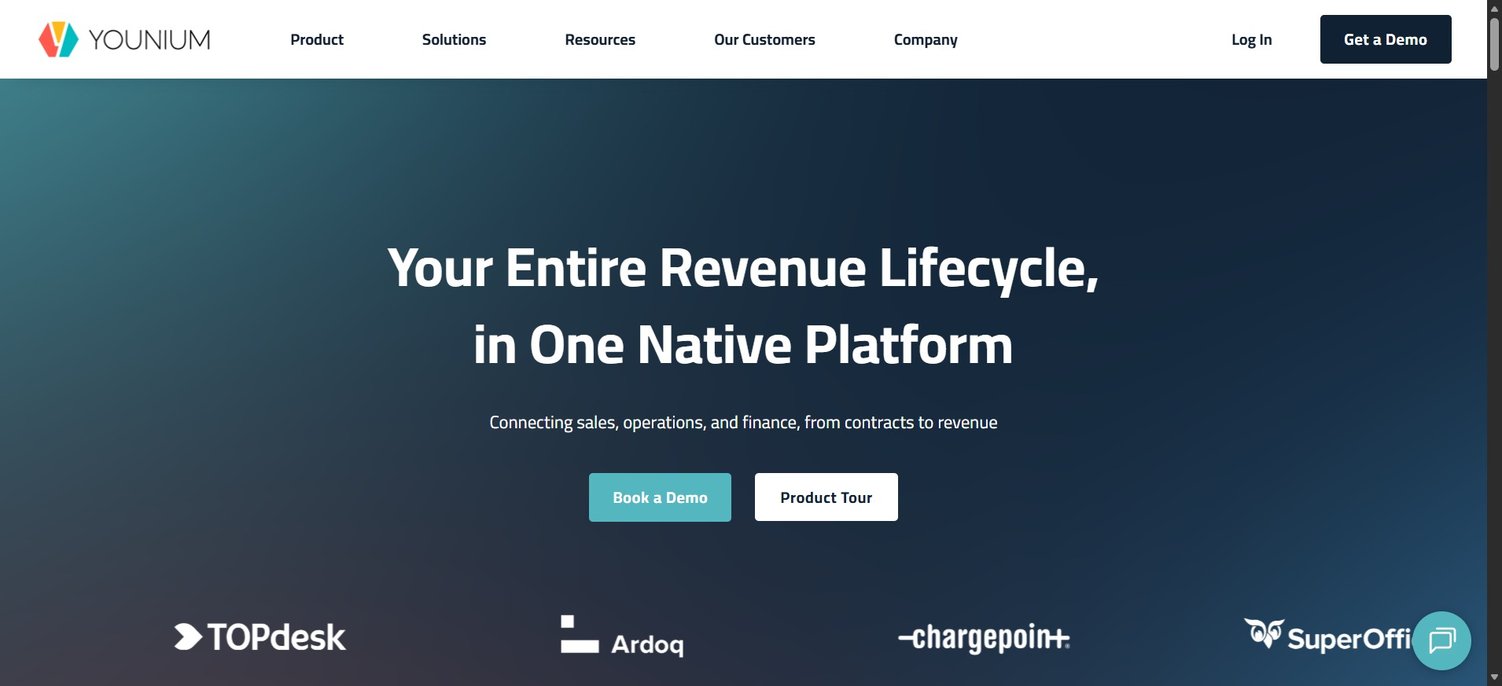
Image via Younium
Younium is a B2B subscription management and billing platform built for companies with multi-entity structures, contract-based pricing, and revenue recognition under ASC 606 or IFRS 15. It pairs subscription management with deep accounts receivable (AR) features, so billing, collections, and reporting run in one place.
Key features
- Automated dunning with two reminder logics – by days since the invoice due date, and by days since the last reminder – plus a self-service payment portal.
- Real-time AR, aging, and metrics reporting across entities and currencies.
- ERP sync to NetSuite, QuickBooks, and Xero via Younium's connectors and API, plus multi-entity and multi-currency consolidation.
- Usage-based, tiered, and hybrid billing, with an MCP integration to connect your own AI securely to Younium for real-time, context-aware finance insights.
Best for: B2B SaaS and subscription businesses that need contract-based billing, multi-entity consolidation, and finance-grade revenue recognition in one platform.
Less suited to: B2C or consumer subscriptions, which fall outside its scope.
Pricing: Custom – priced on the recurring revenue (ARR) Younium manages.
CTA
You May Also Like:
- Revenue Growth Management: What Is It and Why It’s Important
- Raising B2B SaaS funding? Time to Report the Right Metrics
2. Maxio
Maxio homepage
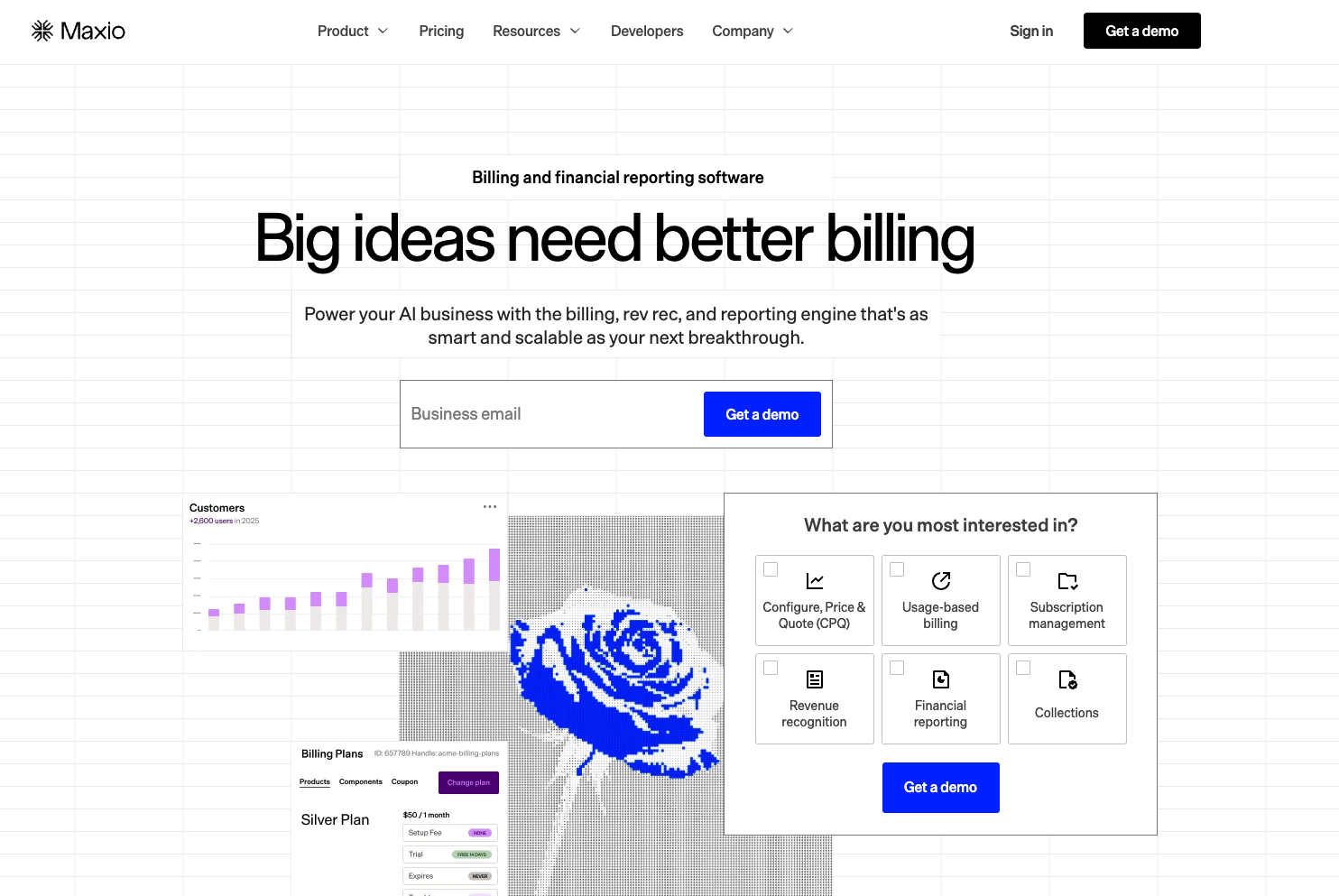
Maxio is a billing and revenue management platform for B2B SaaS and AI companies, formed from the merger of Chargify (billing) and SaaSOptics (revenue recognition). It runs the full subscription lifecycle and is built for fast-growing finance teams that want billing and rev rec in one place.
Key features
- Recurring, usage-based, and one-time billing.
- ASC 606 and IFRS 15 revenue schedules generated automatically.
- SaaS metrics reporting – ARR, churn, deferred revenue.
- AR management and a developer sandbox.
Best for: Fast-growing B2B SaaS teams wanting billing and revenue recognition under one roof.
Less suited to: Teams that want quick onboarding, as setup and reporting carry a learning curve.
Pricing: From $599/month (Grow, up to $100k in monthly billings); Scale is quote-based for higher volumes.
3. Chargebee
Chargebee homepage
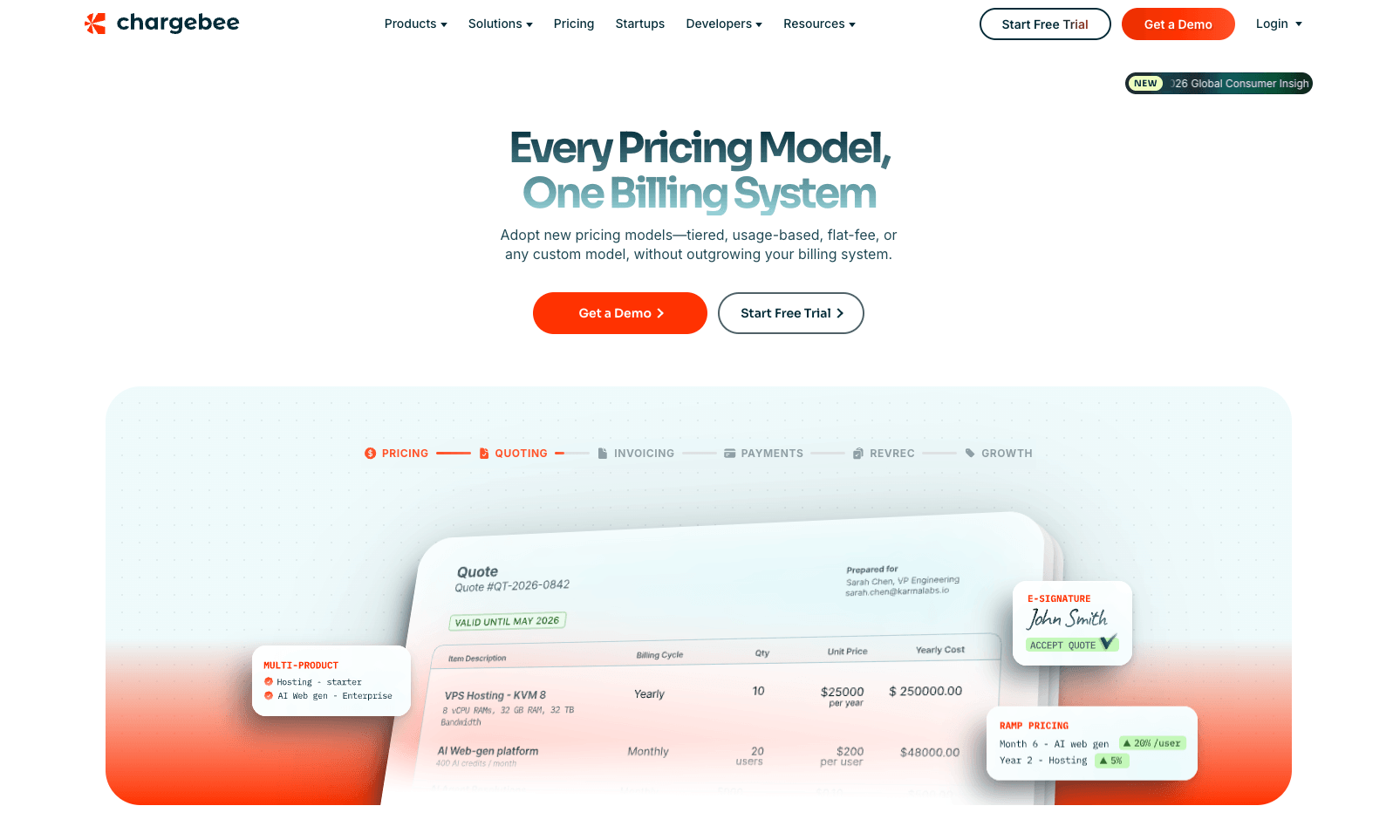
Chargebee is a subscription billing and revenue management platform that runs recurring-revenue operations for SaaS and AI companies across the full lifecycle – trials, renewals, upgrades, downgrades, and cancellations. It has been named a Leader in Gartner's Magic Quadrant for Recurring Billing Applications.
Key features
- Automated recurring invoicing across the subscription lifecycle.
- Revenue recognition and tax management.
- A wide set of payment-gateway integrations.
- Reporting and analytics for recurring revenue.
Best for: Product-led and self-serve SaaS that need flexible billing at scale.
Less suited to: Teams needing deep multi-category report consolidation, which some users find limited.
Pricing: Free Starter (under $250k in cumulative billing); Performance at $599/month; Enterprise custom.
You May Also Like:
- 12 Top Chargebee Alternatives and Competitors in 2026
- Younium vs. Chargebee: Choosing the Right Subscription Platform for B2B SaaS
4. Zuora
Zuora homepage
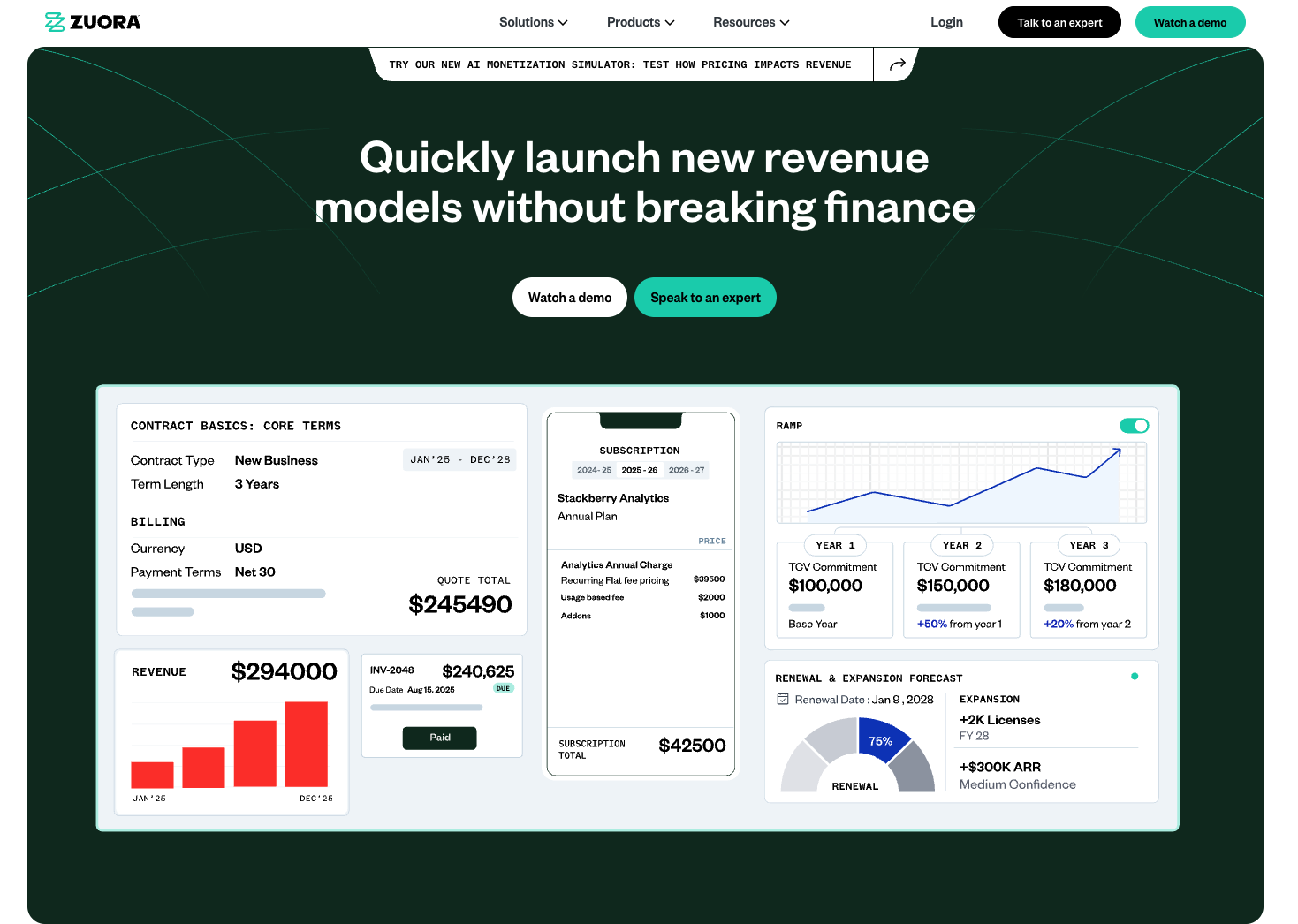
Zuora is an enterprise subscription billing and revenue management platform built for recurring, usage-based, and hybrid pricing at scale. It's aimed at large organizations with high transaction volumes and complex quote-to-cash needs.
Key features
- Subscriptions, invoicing, and payments at enterprise scale.
- Smart dunning and collections workflows.
- ASC 606 / IFRS 15 revenue recognition.
- Integrations with major finance and CRM systems, plus API access.
Best for: Large enterprises with high volumes and complex quote-to-cash.
Less suited to: Smaller teams – heavy to configure, slower time-to-value, and higher cost.
Pricing: Custom, enterprise-oriented.
You May Also Like:
Best Accounts Receivable Software for Mid-Market AR Automation
5. Versapay
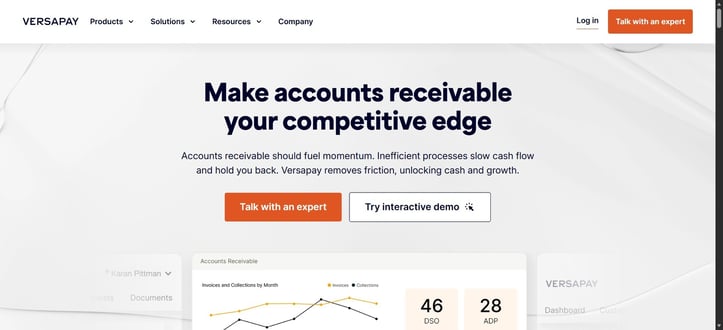
Image via Versapay
Versapay is a cloud-based AR platform known for its collaboration tools, connecting AR teams and customers on a shared space to manage invoices, disputes, and payments. It suits mid-sized to large businesses that want to improve the payment experience and automate collections.
Key features
- Collaborative AR portal connecting teams and customers in real time.
- Automated invoicing, reminders, and online payment rules.
- ACH, check, and card acceptance.
- ERP integration with systems like Oracle and SAP.
Best for: Mid-sized to large businesses wanting collaborative, customer-facing AR with real-time dispute resolution.
Less suited to: Small teams that don't need a shared customer portal.
Pricing: Custom quote, based on invoice and payment volume, users, and ERP integrations.
You May Also Like:
- The Steps of SaaS Success: How to Do Invoicing Right
- Essential Subscription Business Metrics To Track
6. Upflow
Upflow homepage
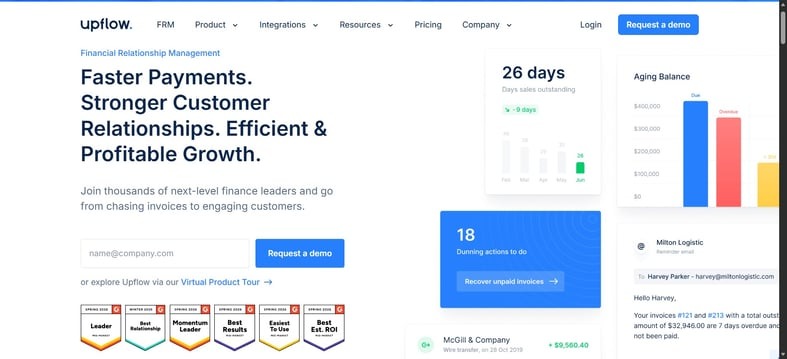
Upflow is an AR tool for B2B companies focused on improving cash inflows and cutting Days Sales Outstanding (DSO). It gives real-time visibility into AR metrics and fosters collaboration between finance departments and sales.
Key features
- Real-time AR analytics with risky-account flagging.
- Automated, personalized reminder workflows.
- One-click integrations with QuickBooks, NetSuite, and Xero.
- Multiple payment methods to speed collection.
Best for: B2B companies focused on lowering DSO and improving cash-flow visibility. Less suited to: Teams that need built-in revenue recognition, which Upflow doesn't handle.
Pricing: Free Discover plan; Grow, Scale, and Strategic plans are quote-based by ARR band.
7. Quadient AR
Quadient homepage
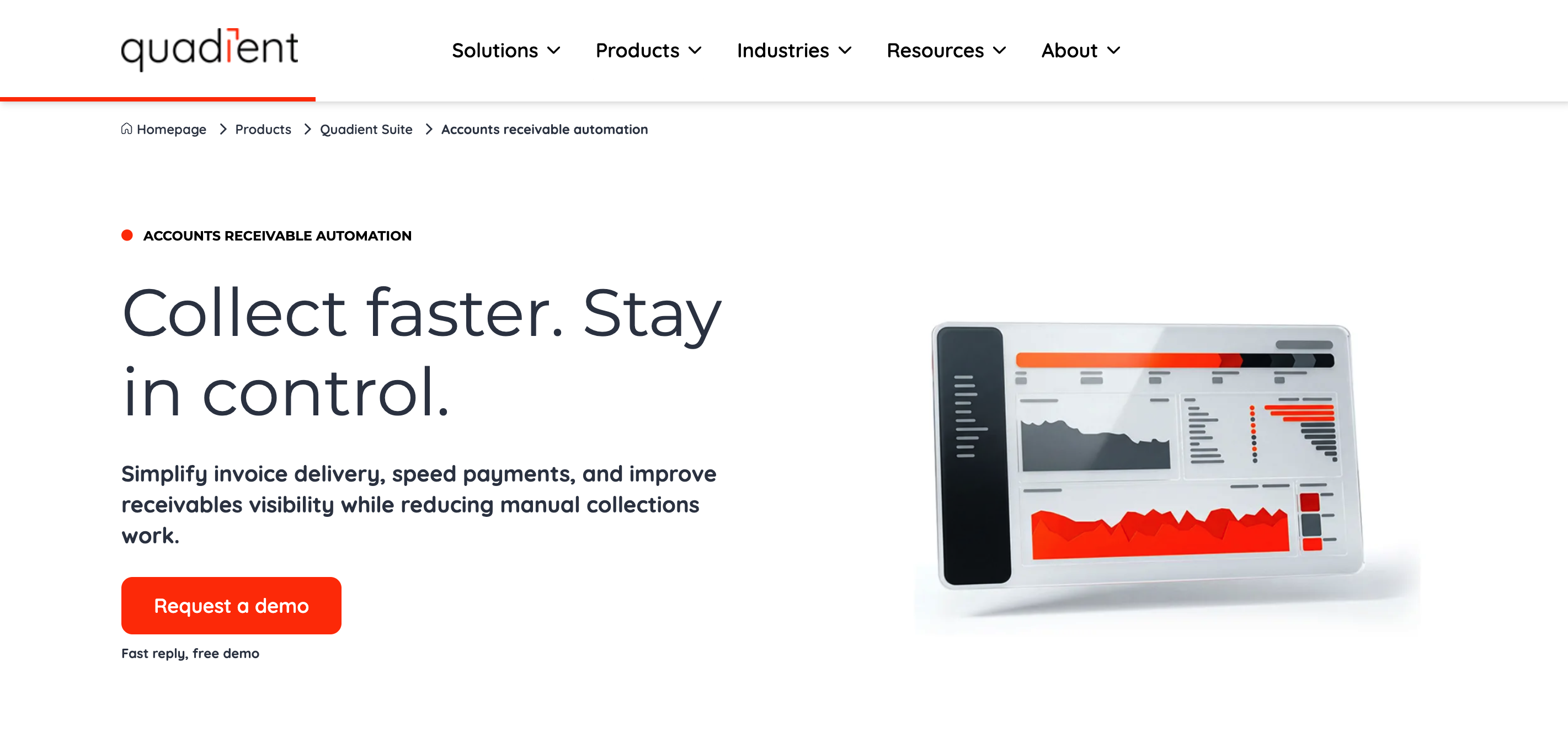
Quadient AR (powered by YayPay) streamlines collections through automation and predictive intelligence, turning AR from a reactive function into an insight-driven one. It fits mid-market and enterprise teams across technology, services, and manufacturing.
Key features
- Customizable dashboards and analytics.
- Automated collections and dispute resolution.
- Predictive cash-flow forecasting.
- Multi-language, multi-currency support across 20+ countries.
Best for: Mid-market and enterprise teams wanting predictive collections and multi-currency support across regions.
Less suited to: Small businesses after a lightweight, low-setup tool.
Pricing: Custom quote, based on invoice volume, users, entities, and modules.
Best accounts receivable software for enterprises
8. HighRadius
HighRadius homepage
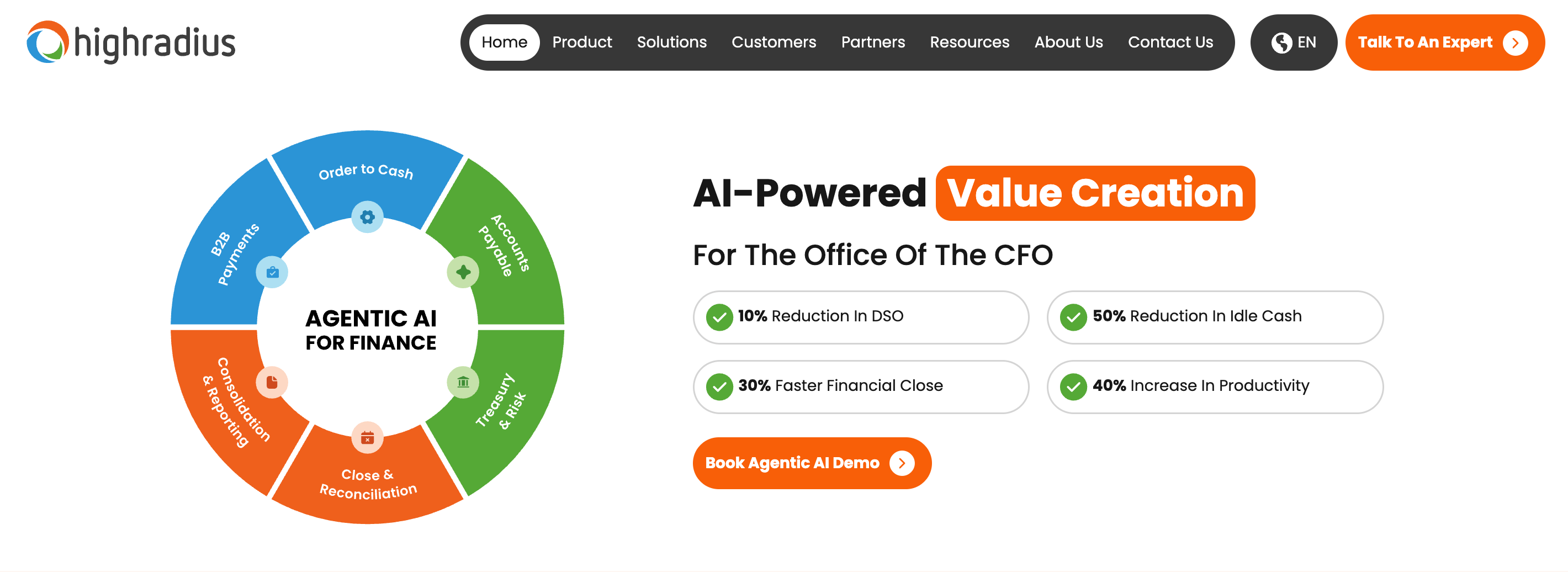
HighRadius is an enterprise AR platform that uses AI to streamline collections, cash application, and deductions. It's built for large organizations managing high transaction volumes and intricate credit or deduction workflows.
Key features
- AI-driven collections prioritization and at-risk account detection.
- Automated, personalized collection outreach.
- AI remittance processing and cash application.
- Deduction management and a customer invoice portal.
Best for: Large enterprises automating high-volume collections, cash application, and deductions with AI.
Less suited to: Smaller teams – it's enterprise-grade, with heavier setup and slower time-to-value.
Pricing: Custom; positioned as a full order-to-cash platform, priced like an enterprise finance system rather than a subscription tool.
You May Also Like:
- Revenue Growth Management: What Is It and Why It’s Important
- Raising B2B SaaS funding? Time to Report the Right Metrics
9. Billtrust
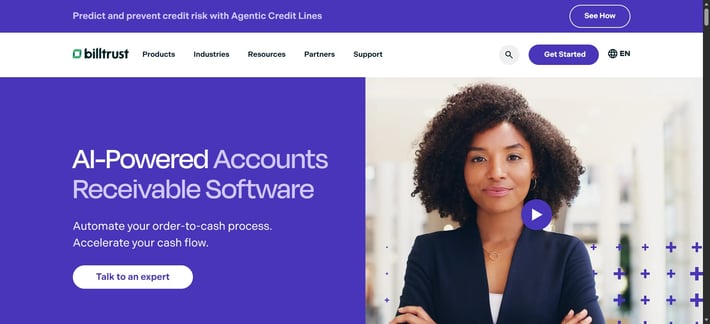
Image via Billtrust
Billtrust brings invoicing, payment processing, cash application, and collections into one platform, giving businesses real-time insight into cash flow. It suits upper-mid-market and enterprise teams that want a single, end-to-end order-to-cash system.
Key features
- End-to-end AR: invoicing, payments, cash application, and collections.
- AI-driven cash application to maximize match rates.
- Automated, customizable collections workflows.
- Multi-channel payments and automated credit management.
Best for: Upper-mid-market and enterprise teams wanting an end-to-end order-to-cash platform.
Less suited to: Small teams – heavier setup and slower time-to-value at lower volumes.
Pricing: Custom enterprise quote.
You May Also Like:
- The Pitfalls of Revenue Recognition in Spreadsheets
- Why Spreadsheets Are Holding You Back in Subscription Management
Best accounts receivable software for SMBs & general accounting
10. BILL
BILL homepage
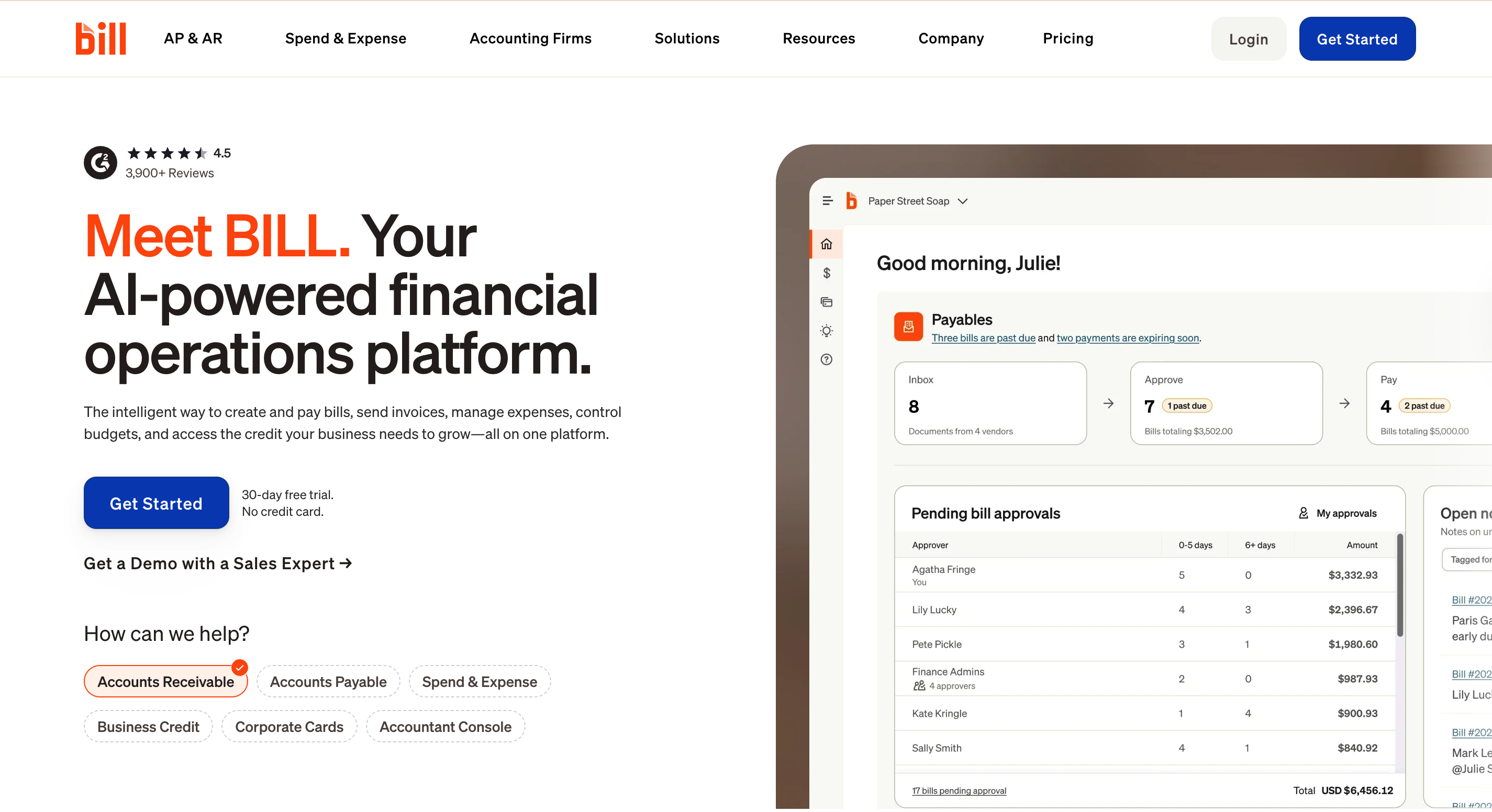
BILL simplifies AR with a straightforward flow: enter, send, track, and get paid. It creates branded invoices, supports recurring billing, and syncs with leading accounting tools – a strong fit for small businesses that want to get paid faster.
Key features
- Branded recurring invoicing with automatic numbering.
- Email and mail delivery, with scheduling.
- Real-time tracking and automated reminders.
- ACH and card payments with auto-reconciliation; QuickBooks and Xero sync.
Best for: SMBs that want straightforward invoicing, reminders, and faster payment with QuickBooks/Xero sync.
Less suited to: Multi-entity or subscription AR.
Pricing: Essentials $45/user/month, Team $55/user/month, Corporate $89/user/month, Enterprise custom.
11. QuickBooks
QuickBooks homepage
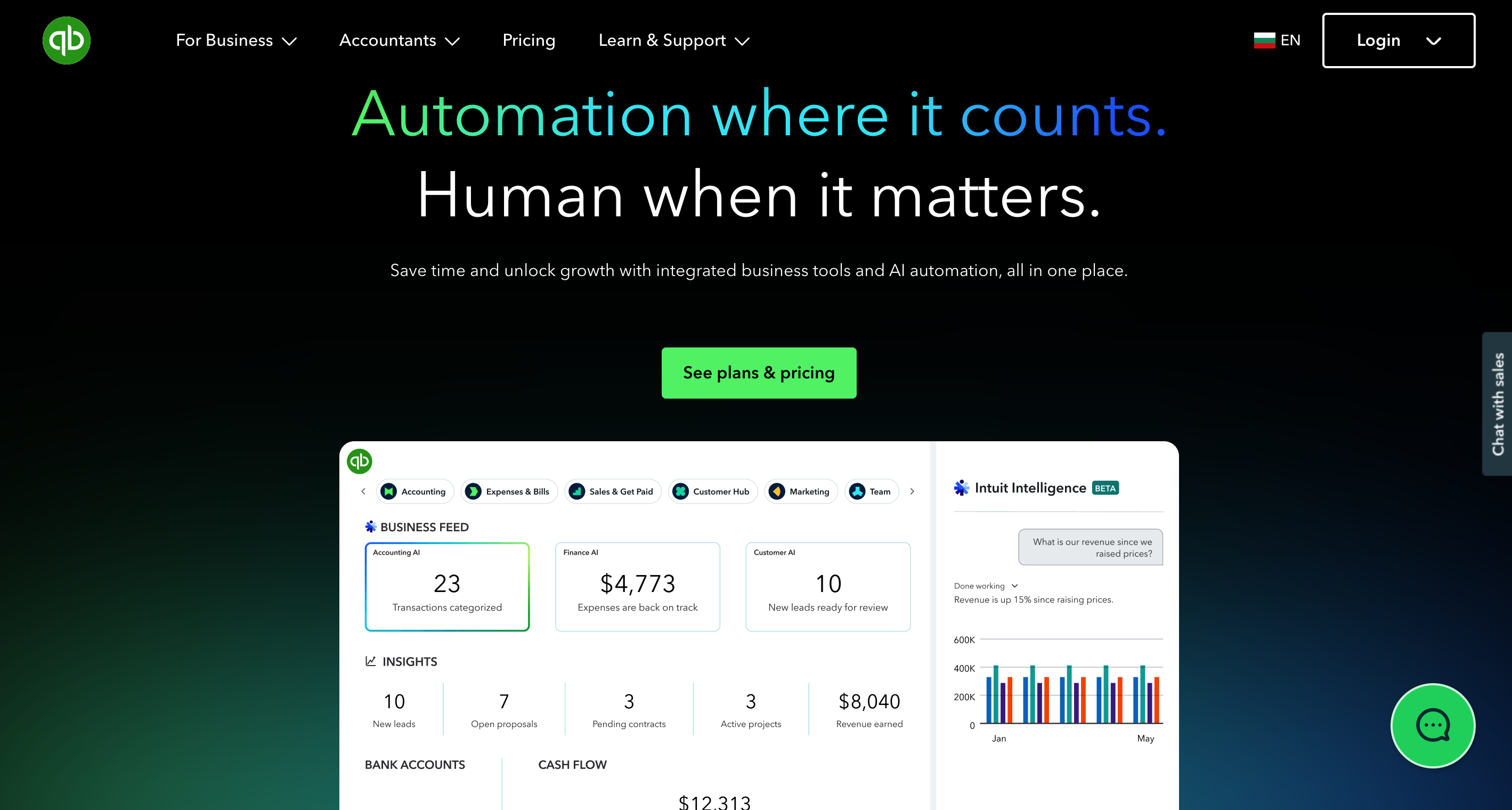
QuickBooks (Online) is general accounting software with built-in AR – invoicing, automatic reminders, and aging reports. It's a common fit for small businesses and general bookkeeping. It's also a frequent Younium integration partner: Younium creates the invoices and revenue schedules upstream, then syncs to QuickBooks for the general ledger.
Key features
- Branded invoicing with recurring schedules.
- Automatic payment reminders.
- Aging reports and AR tracking.
- ACH and card payments with bank reconciliation.
Best for: SMBs running straightforward AR alongside their bookkeeping.
Less suited to: Multi-entity, contract-based, or subscription AR.
Pricing: QuickBooks Online (Small business) – Simple Start $38/month, Essentials $75/month, Plus $115/month, Advanced $275/month, with 50% off for the first 3 months commonly available.
12. FreshBooks

FreshBooks homepage
FreshBooks is a user-friendly, cloud-based AR tool for small businesses and freelancers. It sends professional invoices, tracks payments, and automates reminders – and its mobile apps make it a fit for owners who work on the go.
Key features
- Professional invoicing with open-tracking.
- Customizable automated late-payment reminders.
- iOS and Android mobile apps.
- Client self-serve portal with automatic late fees.
Best for: Freelancers, service businesses, and small-business owners who value mobile invoicing and ease of use.
Less suited to: Multi-entity B2B finance teams.
Pricing: Lite $19/month, Plus $38/month, Premium $65/month, Select custom.
You May Also Like:
- What Is SaaS Analytics and Which Metrics Should You Track?
- Use a Subscription Management Solution As the Foundation for Your SaaS Metrics
Best practices for mastering accounts receivable management
Strong AR management comes down to a few habits: Set clear credit policies and payment terms up front, automate invoicing and payment reminders, track metrics like DSO to catch bottlenecks early, and make it easy for customers to pay through self-service portals and multiple payment methods. The right AR platform turns each of these from a manual chore into a default.
For the full playbook, see our guide to accounts receivable best practices.
How to choose the right accounts receivable software solution
- Identify your needs. Assess company size, industry, current AR processes, and growth plans so the tool can scale with you.
- Prioritize automation. Look for automated invoicing, reminders, and cash application to cut manual work and errors.
- Check integrations. It should connect cleanly with your ERP, accounting, and CRM systems for end-to-end financial visibility.
- Demand real-time insight. Dashboards should surface DSO, payment trends, and collection risk as they happen.
- Weigh payments, usability, and scalability. Multiple payment methods, a self-service portal, an intuitive interface, and room to grow all matter.
Best tool by use case
- B2B SaaS / subscription billing + revenue recognition: Younium – multi-entity, contract-based billing, and ASC 606 / IFRS 15 revenue recognition.
- Enterprise AR automation: HighRadius or Billtrust – AI-driven collections at high volume.
- Collaborative / customer-portal AR: Versapay.
- Cash-flow / DSO focus: Upflow.
- SMB invoicing + AR: BILL or FreshBooks.
- Already on an ERP: NetSuite – or run Younium upstream of it.
You May Also Like:
- Mastering Transaction Readiness: Proactively Increase Your Valuation
- Top Billing Issues with the Recurring Revenue Model
Match your AR software to your business model
The right AR software depends on where your business sits.
- SMBs and freelancers do well with general accounting tools.
- Enterprises need AI-driven collections that hold up at high volume.
- B2B SaaS and subscription companies need something else again: billing, multi-entity consolidation, and revenue recognition that stay accurate under ASC 606 or IFRS 15.
That last group is who Younium is built for. It brings subscription management, billing, and finance-grade revenue recognition into one platform, so your team spends less time reconciling and more time on the numbers that move the business.
If that sounds like your setup, book a demo to see how Younium fits your finance stack.
FAQ
Q1. What is accounts receivable software, and why is it essential for SaaS businesses?
Accounts receivable software is a specialized technological solution designed to manage and optimize the billing and payment collection process.
For SaaS businesses that rely heavily on subscription-based revenue, this software is crucial. Accounts receivable software solutions automate complex billing cycles, track invoices, and provide real-time insights into cash flow. These improve financial efficiency and reduce manual administrative work.
Q2. How does Younium support B2B SaaS companies?
Younium is tailored to meet the needs of subscription-based SaaS companies by providing AI-powered insights and automation. The accounts receivable software solution helps manage recurring billing, track subscription renewals, and automate dunning processes.
Additionally, Younium offers detailed analytics and reporting. This enables SaaS businesses to optimize their revenue operations and maintain healthy cash flow. At the same time, it helps them adhere to compliance standards in various regions.
Q3. Can accounts receivable software integrate with existing accounting systems?
Yes. Most accounts receivable software solutions integrate seamlessly with existing accounting systems. This streamlines data flow, reduces manual data entry, and ensures accurate financial reporting.
Younium has integrations with popular accounting platforms like Xero, QuickBooks, and NetSuite.
Q4. How do you track accounts receivable?
Tracking accounts receivable involves several key methods:
- Monitor invoice aging reports
- Track Days Sales Outstanding (DSO)
- Review customer payment histories
- Analyze real-time dashboards
- Set up automated follow-up processes
- Compare actual collections against projected revenues
- Institute periodic reviews and adjustments
Q5. What does DSO mean?
DSO, or Days Sales Outstanding, is a critical financial metric tracked by accounts receivable software. It measures the average number of days it takes a company to collect payment after a sale has been made.
A lower DSO indicates more efficient accounts receivable management and healthier cash flow. Meanwhile, a higher DSO may signal payment delays or inefficiencies.
Q6. What are the latest trends in AR automation for 2026?
In 2026, accounts receivable automation is evolving rapidly, driven by connected data systems, AI-assisted workflows, and real-time financial visibility needs.
Key trends include:
- Context-connected AI (MCP): Instead of standalone AI copilots, companies now use protocols like the Model Context Protocol (MCP) to securely connect general AI models to their finance systems. This gives AI the context it needs for accurate, compliant insights.
- Real-time reconciliation: Modern AR tools provide live payment matching, exception handling, and automated bank feeds to reduce manual work.
- Multi-entity & multi-currency dashboards: Global finance teams rely on unified, consolidated AR views across countries, currencies, and business units.
- Predictive analytics for collections: AI-supported insights help teams forecast late payments, prioritize accounts, and optimize follow-up strategies.
- Integrated revenue operations: AR systems now tie directly into CRM, ERP, and subscription platforms for a single source of financial truth. These trends reflect a shift from “automation as a tool” to automation as an intelligent, connected financial workflow.
Q7. How does Younium’s MCP integration improve AR performance?
Younium uses the Model Context Protocol (MCP) to allow businesses to connect their preferred AI models directly to their Younium environment. This gives the AI secure access to the real operational context behind AR processes – invoices, payments, workflows, customer histories, subscription data, and more.
With this context, AI becomes accurate, reliable, and actionable, enabling:
Predictive collections insights: Forecast late payments, identify at-risk customers, and prioritize outreach based on historical and behavioral patterns.
- Exception automation: Automatically flag inconsistencies, unmatched payments, anomalies in subscription billing, or unusual cash application behavior.
- On-demand KPI reporting: AI can instantly produce explanations, summaries, and trend analyses for metrics like DSO, overdue amounts, churn indicators, cash flow projections, and revenue leakage risks.
- Faster decision-making: Teams get precise answers grounded in their real data, without exporting spreadsheets or cross-checking multiple systems. Instead of introducing a separate “AI copilot,” Younium’s MCP approach ensures AI works natively with your existing systems, delivering insights that are compliant, contextual, and connected to your full financial environment.
Q8. Can QuickBooks do accounts receivable?
Yes. QuickBooks handles core AR – invoicing, payment reminders, and aging reports. It isn't built for multi-entity, contract-based, or subscription AR, though, which is where dedicated AR and subscription platforms fit. Many teams run QuickBooks as their general ledger and layer a subscription-AR tool on top.
Q9. What's the difference between QuickBooks and a specialized tool like Billtrust?
QuickBooks is general accounting software with basic AR built in. Billtrust is purpose-built AR automation – cash application, collections, and a customer payment portal – designed for higher invoice volumes than general bookkeeping software is meant to handle.