
Subscription Billing
Discover the top subscription billing platforms for managing recurring billing processes. Compare their features to find the best fit for your SaaS business.
Jump to Read
How to evaluate subscription billing platforms
Best Subscription Billing Platforms for You to Try
Customizable and hybrid B2B SaaS revenue platforms
Enterprise and usage-based billing
Developer-first and self-serve
Merchant of record platforms
Open source and usage metering
Accounting-led and SMB
FAQ
Which Subscription Billing Platform Should You Choose?
A subscription billing platform automates recurring payments and manages the full subscription lifecycle – invoicing, prorations, dunning, and revenue recognition. For SaaS companies that live on recurring revenue, it's what keeps that revenue accurate as pricing gets more customizable: tiered plans, usage-based charges, and hybrid models running side by side.
That's a different job from a payment gateway. A gateway processes a single transaction; a billing platform runs the whole ongoing relationship, including revenue recognition and failed-payment recovery. That gap matters most for B2B SaaS teams running customizable pricing, multi-entity operations, or hybrid billing – the point where manual workarounds usually start to break.
To help you choose the best option for your business, we reviewed the top solutions and curated a list of the 12 best subscription billing platforms. Of the 12, Younium is the pick for B2B SaaS teams with customizable or hybrid revenue and multi-entity revenue recognition; the rest fit narrower needs. Each platform has been evaluated for its automation features, pricing flexibility, integration options, revenue accuracy, and suitability for B2B SaaS companies.
Also Read:
- What is SaaS Billing? Best Practices and How-To Guide
- How to Streamline Financial Processes with Subscription Billing Platforms
How to evaluate subscription billing platforms
If your business uses a subscription or recurring revenue model, choosing the right billing software is one of the most important decisions you’ll make. Beyond sending invoices, modern billing systems must support usage-based charges, revenue recognition, multi-currency billing, automated dunning, and a unified source of financial truth.
1. Pricing structure and fees
Subscription billing platforms use different pricing models, including flat-rate, usage-based, and revenue-sharing structures. To avoid surprises, evaluate:
- transaction fees
- add-on charges
- customer or invoice limits
- long-term scalability costs
Some platforms charge based on the number of invoices or customers, which can affect costs as the business scales. Look for a transparent pricing model that aligns with your revenue strategy and growth projections.
2. Integration with other tools
A good subscription billing platform should integrate with your existing business tools, like:
- CRM
- accounting software
- payment gateway connectors
Proper integration can streamline your business workflows.
Prioritize platforms with robust APIs, prebuilt connectors, and webhook support, ensuring real-time data flow and eliminating manual reconciliation between tools.
3. Scalability and flexibility
Your business will grow with time, and your subscription billing platform should be able to grow with you. Consider whether the platform can handle increasing transaction volumes, expanding customer bases, and the addition of new subscription plans or pricing tiers.
A flexible platform allows you to easily adapt to changing market demands and customer preferences without requiring costly and time-consuming migrations.
4. Customer support and onboarding
Another factor to consider when choosing subscription billing platforms is customer support. Consider whether the provider offers dedicated account management or personalized training to help you get started.
You should also look for documentation, tutorials, and responsive support channels for a smooth onboarding process.
5. Reporting and analytics
Analytics are key to tracking the performance of your subscription metrics and business. The best subscription billing software solutions track key SaaS metrics, such as customer churn or revenue growth, and automate revenue recognition under ASC 606 and IFRS 15, so the finance view stays audit-ready.
Your platform should provide:
- real-time dashboards
- ARR/MRR reporting
- churn and expansion insights
- revenue recognition automation
- exportable data for BI tools
A good subscription management platform should offer real-time reporting, customizable dashboards, and the ability to export data for further analysis. These features enable you to make informed decisions about pricing and how to collect payments.
6. Pricing model flexibility
This is separate from what the tool costs you (factor 1) – it's whether the platform can bill your customers the way you actually price them. Look for per-seat, per-usage, tiered, and hybrid billing in one system, so a new pricing model doesn't mean a workaround or a rebuild.
7. Automation
The point of a billing platform is that billing runs without you. Invoices are automatically generated, sent, and reconciled on a schedule, and renewals, upgrades, downgrades, and prorations apply on their own. Check how much of the billing cycle a platform runs end-to-end, and where it still needs someone to step in.
8. Global tax
If you sell across borders, tax handling belongs on the checklist. Some platforms calculate and remit sales tax, VAT, and GST for you, and a merchant of record takes on the liability entirely; others expect you to bolt on a separate tax engine. Confirm which model fits the markets you sell into.
9. Dunning and failed-payment recovery
Failed payments, i.e., an expired or declined card rather than a deliberate cancellation, cause an estimated 20–40% of subscription churn, and most of it is recoverable. A billing platform should retry failed charges automatically, keep card details current with card-updater support, and prompt customers before a subscription lapses. Check whether recovery is built in or expects a bolt-on tool, and how much of failed payments it actually recovers.
Also Read:
- Top Accounts Receivable (AR) Software Solutions
- A Tactical Buyer's Guide for Subscription Management Solutions
Best Subscription Billing Platforms for You to Try
When choosing a subscription billing platform, look for one that can efficiently manage recurring payments, handle invoices, and support revenue growth.
|
Platform |
Best for |
Key strength |
Pricing model |
|
Younium |
B2B SaaS with customizable/hybrid revenue and multi-entity rev rec |
Order versioning + ASC 606 / IFRS 15 revenue recognition |
Custom (ARR-based) |
|
Maxio |
Finance-heavy B2B (SaaS metrics + rev rec) |
Chargify billing + SaaSOptics rev rec |
Grow from $599/mo; Scale custom |
|
Chargebee |
Growth-stage B2B subscription management |
Broad integrations, Gartner-recognized |
Free to $250K billed, then 0.75%; Performance $599/mo |
|
Zuora |
Large enterprise with heavily customized contracts |
Enterprise quote-to-cash breadth |
Custom (quote-based) |
|
BillingPlatform |
Enterprise usage-based billing |
Configurable enterprise revenue management |
Custom (quote-based) |
|
Stripe Billing |
Developer-led startups / PLG |
Powerful API, fast to launch |
0.5–0.8% of recurring payments + processing fees |
|
Recurly |
Retention / dunning focus, self-serve subscriptions |
Churn management, multi-gateway |
From $249/mo |
|
Paddle |
Global sellers wanting tax + compliance handled |
Merchant of record |
5% + 50¢ per transaction |
|
FastSpring |
Global digital-goods sellers |
Merchant of record, tax handled globally |
Custom (~5–8% commission) |
|
Lago |
Engineering teams wanting open-source usage billing |
Open-source, event-based metering |
Free self-hosted; paid cloud tiers |
|
Zoho Billing |
SMBs already in the Zoho ecosystem |
Low cost, quick setup |
From ~$50/mo |
|
Sage Intacct |
Finance teams wanting accounting + billing in one |
Accounting-native automation |
Custom |
We compared each platform on automation, pricing flexibility, integrations, revenue recognition, and B2B-SaaS fit.
Customizable and hybrid B2B SaaS revenue platforms
1. Younium
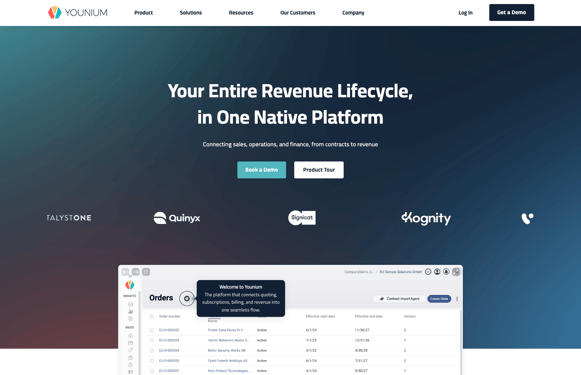
Image via Younium
Younium is the subscription billing platform for B2B SaaS companies with customizable and hybrid revenue models – it runs the full revenue lifecycle, from pricing and quoting to invoicing, usage, and revenue recognition, in one system.
What sets Younium apart is order versioning: Every subscription change (seats up or down, a mid-term renegotiation, an add-on) creates a new version of the same order with full proration, so finance can report new business, expansion, and downsell separately. It bills usage-based and hybrid models the same way, without the custom development that lighter tools need.
Another major differentiator is Younium’s support for the Model Context Protocol (MCP). MCP allows businesses to securely connect their own internal AI systems to Younium’s data – giving AI full context across contracts, invoices, usage records, revenue schedules, and customer activity.
This enables highly accurate insights, anomaly detection, and automated workflows grounded in real operational data. With ERP, CRM, and payment gateway integrations out of the box, Younium provides a quote-to-cash experience while maintaining a single source of financial truth.
Best for: B2B SaaS companies with customizable or hybrid revenue models and multi-entity revenue recognition.
Less suited to: Consumer (B2C) or high-volume, flat-rate subscriptions where a lighter tool does the job. ✨Customer spotlight: Kognity reported 6x efficiency gains after moving to Younium, and iBinder cut costs by 30%.
Key Features
- Multi-company and multi-currency support.
- Revenue recognition compliant with ASC 606 and IFRS 15.
- Flexible billing schedules with discounting and proration options.
- Custom dashboards and real-time reporting.
- Milestone tracking for contract-based billing.
- Metrics overview to track key SaaS KPIs, such as MRR, ARR, churn, and expansion revenue.
- Advanced reporting engine with CSV/Excel export.
- Plug-and-play integrations with open REST API.
Pricing
- Younium offers custom pricing based on business needs. Contact the team for a tailored quote.
2. Maxio
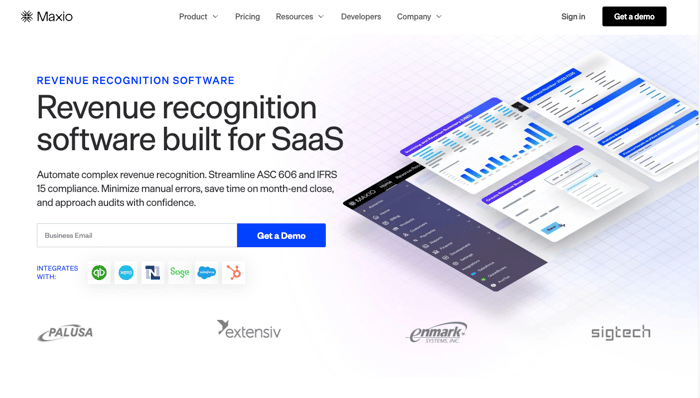
Maxio homepage
Maxio pairs Chargify billing with SaaSOptics revenue recognition, which fits finance-heavy B2B teams that don't need order-versioned, multi-entity rev rec.
Less suited to: Teams wanting a lightweight, quick-start tool.
Key Features
- Reporting and analytics dashboards
- Invoicing capabilities
- Automatic renewals and upgrades management
Pricing
- Build: Free for 30 days
- Grow: $599/month for businesses with up to $100k in monthly billings
- Scale: Custom pricing for businesses with over $100k in monthly billings
3. Chargebee
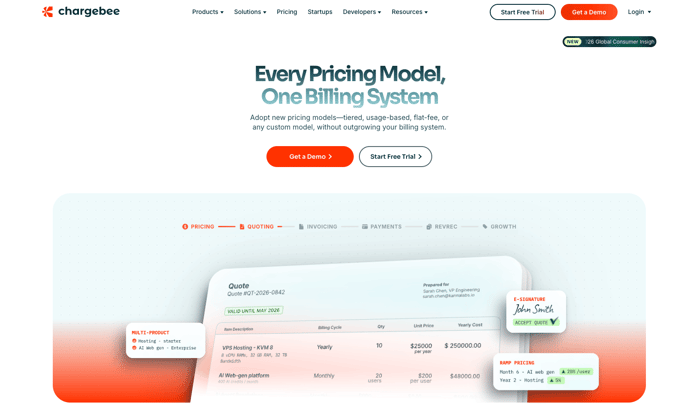
Chargebee homepage
Chargebee is a Gartner-recognised B2B billing platform whose reporting depth and multi-entity consolidation get harder as teams scale. It's not ideal for multi-entity consolidation and finance teams that need order-versioned revenue recognition out of the box.
Key Features
- Subscription lifecycle management with trials, upgrades, and cancellations
- Automated dunning and revenue recovery
- Usage-based, tiered, and hybrid pricing
- Revenue recognition and SaaS metrics reporting
- Broad CRM, accounting, and payment-gateway integrations
Pricing
- Starter: free up to $250K in cumulative billing, then 0.75% on additional revenue
- Performance: $599/month (up to $100K monthly billing, then 0.75%)
- Enterprise: custom pricing
Also Read:
- Younium vs. Chargebee: Choosing the Right Subscription Platform for B2B SaaS
- 12 Top Chargebee Alternatives and Competitors in 2026
Enterprise and usage-based billing
4. Zuora
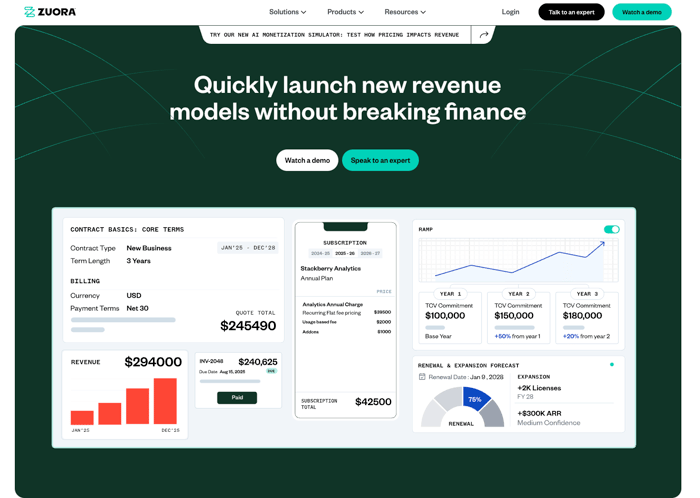
Zuora homepage
Zuora is an enterprise-grade subscription and revenue platform built for large organizations running broad quote-to-cash operations across heavily customized contracts. That breadth is both its strength and its cost: Setup is heavier, and implementations are widely reported in the $5K–$50K+ range with a steeper learning curve than lighter tools. Smaller teams with straightforward models often find it a bit overwhelming for their actual needs.
Best for: Large enterprises with high volumes and heavily customized contracts.
Less suited to: Smaller teams that want fast time-to-value and simple setup.
Key Features
- Enterprise subscription lifecycle and order management.
- Usage-based, tiered, and hybrid pricing at scale.
- Revenue recognition aligned to ASC 606 and IFRS 15.
- Quote-to-cash across CPQ, billing, and collections.
- Extensive enterprise integrations and API.
Pricing
- Custom, quote-based pricing (enterprise deals; implementation costs are typically significant)
5. BillingPlatform
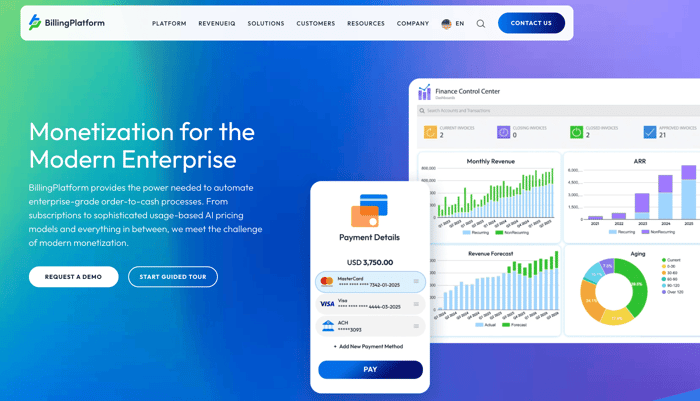
Billing Platform homepage
BillingPlatform is an enterprise revenue-management and billing solution built for high-volume, customizable billing, including usage-based and dynamic pricing. Gartner and MGI Research have recognized it as a market leader for automated revenue management. Its configurability suits large teams; it's more than most smaller businesses need.
Best for: enterprises with high-volume, customizable, or usage-based billing.
Less suited to: Small teams that want a quick, low-configuration setup.
Key Features
- Configurable enterprise billing for any pricing model.
- Usage-based and consumption billing at scale.
- Revenue recognition automation.
- Quote-to-cash across the revenue lifecycle.
- Cloud-based, multi-tenant architecture with open API.
Pricing
- Custom, quote-based pricing.
Developer-first and self-serve
6. Stripe Billing
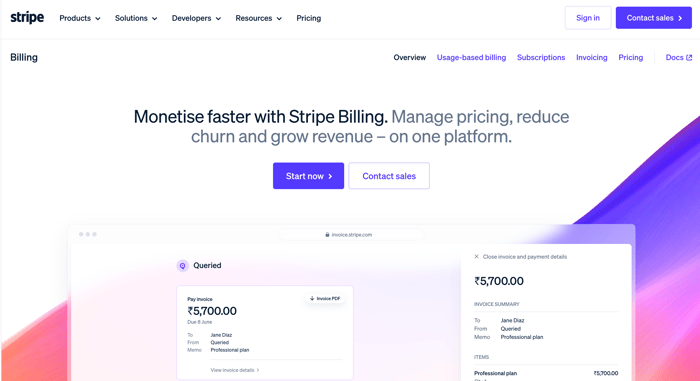
Stripe Billing homepage
Stripe Billing extends Stripe's payments stack into recurring billing, invoicing, and subscription management. It's developer-first: most of its power comes through the API, which makes it quick to launch for engineering-led teams but harder for finance teams that want no-code control. Native CPQ and ASC 606 revenue recognition aren't part of the lower tier, so B2B finance orgs often add tooling on top.
Best for: Developer-led startups and product-led (PLG) businesses.
Less suited to: Multi-entity B2B finance and native ASC 606 revenue recognition.
Key Features
- Recurring billing and invoicing built on Stripe payments.
- Usage-based and tiered pricing (higher tier).
- Smart retry logic and revenue recovery tools.
- Revenue recognition and analytics on the Scale tier.
- Full REST API and extensive developer documentation.
Pricing
- Billing Starter: 0.5% on recurring payments.
- Billing Scale: 0.8% on recurring payments (adds revenue recognition, usage-based billing, and quoting).
- Plus standard Stripe processing fees (2.9% + 30¢); custom pricing for high volume.
7. Recurly
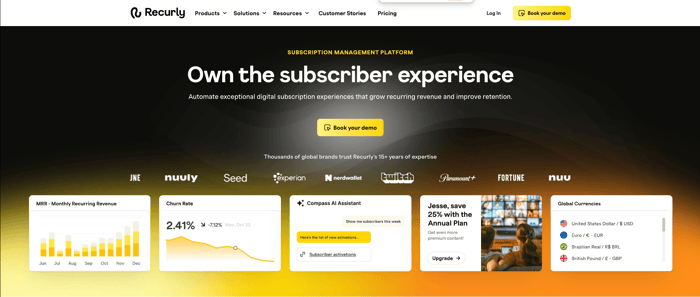
Recurly homepage
With 16+ years in the market, Recurly is a widely used recurring-billing tool with a strong focus on retention and dunning, offering automated billing, revenue recognition, and churn management.
You can customize pricing tiers and plans, manage promotional offers, and gain insights through its advanced analytics. Recurly’s multi-gateway payment system supports global transactions and allows payments in multiple currencies. It also integrates with various third-party applications, including CRM software, accounting software, and marketing automation tools.
Best for: Retention- and dunning-focused recurring billing and self-serve, high-volume subscriptions.
Less suited to: Multi-entity B2B finance and native ASC 606 revenue recognition.
Key Features
- Automated recurring billing and invoicing.
- Dunning management to reduce payment failures.
- Revenue recognition and financial compliance.
- Advanced analytics and reporting tools.
- Multi-gateway payment processing with global support.
- Customizable pricing models, including usage-based billing.
- Subscriber lifecycle management and engagement tracking.
Pricing
- Starter Plan: Free trial available for three months, then $249/month.
- Professional Plan: Custom pricing based on business needs.
- Elite Plan: Enterprise-level solution with custom pricing.
Merchant of record platforms
8. Paddle
Paddle homepage
Paddle acts as a merchant of record, handling billing, sales tax, and compliance on your behalf. It lets you handle multi-product subscriptions, flexible billing cycles, and international transactions.
Paddle’s fraud protection tools add another layer of security, helping businesses reduce risks. It also offers a full REST API to integrate with various payment systems.
Best for: Global sellers who want merchant-of-record tax handling.
Less suited to: businesses needing multi-entity finance control and native revenue recognition.
Key Features
- Global tax compliance, automatic remittance of sales tax
- Multi-product subscriptions, multi-seat plans, and add-ons
- Automated recurring billing with full tax compliance
- Multiple payment options, including credit cards and alternative methods
- Automated dunning features to reduce churn rate and improve retention
- Full REST API for integration with detailed documentation
- GDPR, SOC2, and 3D-Secure 2 compliance for enhanced security
Pricing
- Pay-As-You-Go Plan: 5% + 50¢ per transaction
- Custom plan: Tailored pricing for larger businesses
9. FastSpring
FastSpring homepage
FastSpring is a merchant of record that manages global SaaS subscriptions, taxes, and payments on your behalf.
It allows you to set up different subscription models, including free trials and multiple pricing tiers. It also provides self-service portals for managing their accounts.
As a merchant of record, it collects and remits sales tax and VAT, and keeps track of the tax requirements for the different countries you accept payments from.
Best for: Global digital-goods sellers wanting merchant-of-record tax handling.
Less suited to: B2B contracts and multi-entity billing.
Key Features
- Tax collection and automatic remittance
- Subscription revenue monitoring and reporting dashboards
- Automatic payment routing
- Access to various localized payment methods and 20+ currencies
- Automatic quotes and invoice generation
- Integration with CRM, marketing, and content management platforms
- Branded embedded checkouts
Pricing
- Contact the sales team for pricing information.
Open source and usage metering
10. Lago
Lago homepage
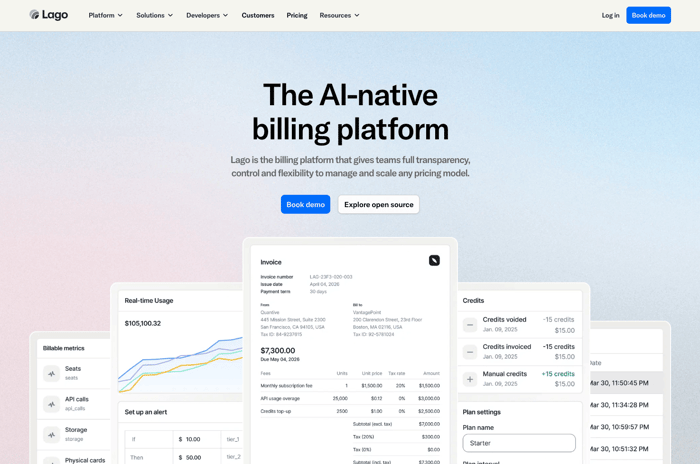
Lago is an open-source, event-based billing platform built for usage-based and hybrid pricing. Engineering teams can self-host it for full control over their data, or use Lago Cloud to get started faster, and its event pipeline is built for high-volume metering.
It gives developers granular control, but finance teams that need built-in revenue recognition and accounts receivable out of the box will find it lighter than a finance-first platform.
Best for: Engineering teams that want open-source, self-hosted usage billing.
Less suited to: Finance teams that need native rev rec, AR, and reporting without engineering effort.
Key Features
- Open-source, event-based metering and usage billing
- Subscription management and pricing iterations
- Self-hosted (including on-premise) or managed cloud
- Payment orchestration and revenue analytics
- Developer-first API
Pricing
- Open-source and free to self-host; managed Lago Cloud offers paid tiers.
Accounting-led and SMB
11. Zoho Billing
Zoho Billing homepage
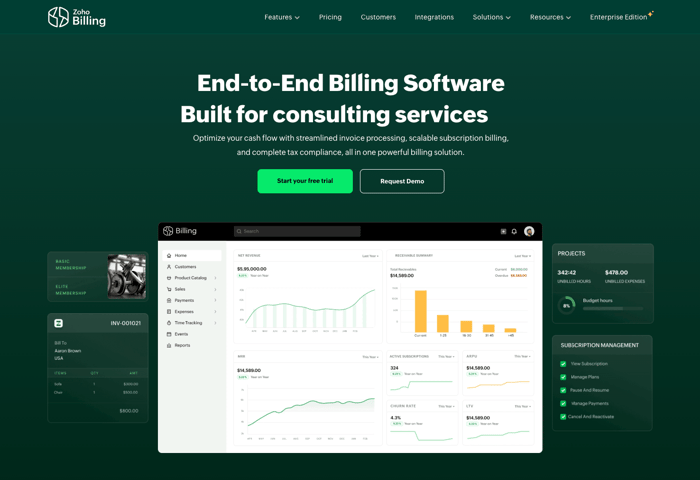
Zoho Billing handles recurring billing and subscription management and fits teams already using the wider Zoho suite. It’s a solid solution for complicated billing cycles, managing customer subscriptions, and automating invoicing and payment collection.
Zoho Billing lets you offer simple monthly plans, as well as usage-based billing to meet diverse client needs.
Additionally, the platform has features to monitor key metrics like subscription sales, revenue, and churn, e allowing for more informed decisions for business growth.
Best for: SMBs already in the Zoho ecosystem.
Less suited to: Multi-entity B2B revenue recognition.
Key Features
- Customer lifecycle management, including trials, upgrades, and cancellations.
- Secure payment links and hosted payment pages.
- Mobile app access for managing billing on the go.
- Low-code customization for tailored workflows and modules.
- Multi-entity support for global operations.
- Comprehensive product catalog management.
- Automated invoice creation with tax calculations.
Pricing
- Standard: $29/organization/month.
- Premium: $69/organization/month.
- Custom: Based on an organization’s needs.
12. Sage Intacct
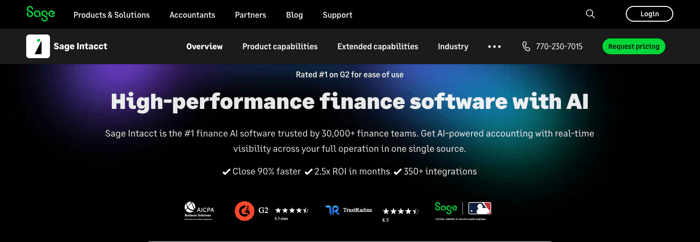
Sage Intacct homepage
Sage Intacct is an accounting-first platform that automates core financial processes, including accounts payable, alongside recurring SaaS billing.
It has an Intelligent General Ledger that helps automate the accounting processes and enables real-time reporting, giving you up-to-date financial data such as powerful dashboards and insights into a company’s payment performance.
Best for: Finance teams wanting accounting and billing in one system.
Less suited to: Teams needing subscription-native features like order versioning.
Key Features
- AI-powered accounting for automated financial processes.
- Multi-entity support for global operations.
- Accounts payable automation to reduce manual workload.
- Accounts receivable management to improve cash flow.
- Intuitive budgeting for real-time expense monitoring.
- Advanced dashboards and reporting for financial insights
Pricing
- Quote-based plans, which are available upon request.
Also Read:
- What is Subscription Billing? A Guide for SaaS Businesses
- How to Create a Subscription Revenue Model Template
Which subscription billing platform should you choose?
The right subscription billing platform comes down to how you sell, not a feature checklist.
If you're a B2B SaaS company with customizable or hybrid revenue and multi-entity revenue recognition, Younium is built for exactly that – order versioning and ASC 606 / IFRS 15 revenue recognition that lighter tools only manage with workarounds.
The rest of this list covers where the field is strong, so you can weigh it honestly: enterprises with heavily customized or usage-based contracts have Zuora and BillingPlatform; early-stage developer-led teams often start on Stripe Billing (or Recurly for retention-led, self-serve billing); sellers who want tax handled entirely use a merchant of record like Paddle or FastSpring; and Lago covers open-source usage metering. Each of those trades away the multi-entity, order-versioned revenue recognition that finance teams move to Younium for.
Each of the subscription billing platforms listed in this post brings unique strengths to the table. If you're a B2B SaaS company weighing customizable pricing, usage-based models, or multi-entity revenue recognition, see how Younium handles it.
Book a demo or size the impact with our ROI calculator.
FAQ
1. What makes Younium different from other subscription billing platforms?
Younium is a leading subscription billing platform that stands out because it is more than a billing tool – it is a complete subscription management and revenue operations platform built specifically for B2B SaaS companies. While many billing platforms focus on simple recurring charges, Younium supports customizable subscription models, including:
- Tiered and tiered-with-overage pricing.
- Usage-based and consumption billing.
- Hybrid pricing structures.
- Contract-based and milestone billing.
- Multi-entity and multi-currency operations.
Younium also supports ASC 606 and IFRS 15 revenue recognition – audit-ready under both standards, which many lightweight billing tools cannot handle natively.
Another key differentiator is Younium’s support for the Model Context Protocol (MCP), enabling companies to connect their own AI securely to real subscription and financial data. This gives AI accurate context for reporting, anomaly detection, pricing analysis, and workflow automation. Finally, Younium integrates deeply with ERP, CRM, accounting, and payment systems, providing a unified quote-to-cash experience and eliminating data silos across finance, revenue, and operations.
2. What are the key features to look for in subscription billing platforms?
To select the best subscription billing platforms for your business, you need to consider several factors, including:
- Flexible pricing and plans: A good platform should support multiple pricing models.
- Automated invoicing and payments: Consider subscription billing platforms that can generate invoices, send reminders, and process payments automatically.
- Customer self-service portal: Customers should be able to manage their subscriptions easily. A self-service portal allows them to upgrade, downgrade, pause, or cancel plans without contacting support.
- Analytics and reporting: Insights into billing performance can help businesses grow. Look for any subscription billing platform that offers real-time revenue tracking and customer behavior insights.
- Integration: Your subscription billing system should be able to integrate with other existing business tools.
3. Can I switch subscription billing platforms without disrupting my business?
Yes, but it requires careful migration. Choose a platform like Younium that offers data import tools, API support, and dedicated customer assistance for smooth onboarding.
4. Do subscription billing platforms handle different payment methods?
Yes, subscription billing platforms provide a wide variety of payment methods. These can include credit and debit cards, PayPal, bank transfers, digital wallets, and even mobile payment options like Apple Pay or Google Pay. Many subscription billing platforms even integrate with popular payment gateways to cater to different customer preferences.
5. How does a subscription billing platform handle taxes?
Subscription billing platforms usually include tax management features to automatically calculate taxes based on customer location, product or service type, and applicable tax laws. Some subscription billing platforms integrate with tax software to handle complex tax calculations, including VAT, sales tax, or GST.
For sellers who want the liability handled entirely, a merchant of record like Paddle or FastSpring calculates and remits tax on your behalf across countries.
6. How do Stripe Billing, Chargebee, and Recurly compare?
They solve different problems.
- Stripe Billing is developer-first and fastest for engineering-led teams, but leans on the API and lacks native CPQ and ASC 606 rev rec on lower tiers.
- Chargebee is a broad B2B subscription platform with wide integrations, strong for growth-stage SaaS.
- Recurly focuses on retention and dunning for high-volume, self-serve subscriptions.
B2B finance teams running customizable or multi-entity models often outgrow all three and move to a finance-first platform.
7. Which platforms handle usage-based and hybrid pricing?
Usage-based pricing charges by consumption – per API call, per seat, per GB; hybrid pricing combines a recurring base fee with usage on top. Most modern platforms support tiered pricing, but native usage-based and hybrid billing is less common. Younium, BillingPlatform, and Lago handle usage and hybrid models natively, while simpler tools often need engineering workarounds.
8. What's the difference between a subscription billing platform and a payment gateway?
A payment gateway authorizes and captures a single transaction. A subscription billing platform runs the whole recurring relationship – plans, invoicing, prorations, dunning, and revenue recognition – and connects to one or more gateways to move the money. Payment orchestration tools such as Spreedly route transactions between gateways, but don't manage the subscription lifecycle themselves.
9. How does dunning work, and how much revenue can it recover?
Dunning is the automated process of retrying failed payments and prompting customers to update their details before a subscription lapses. Failed payments (involuntary churn) account for roughly 20–40% of subscription churn, and most of it is recoverable. Retries, card-updater support, and timed reminders recover a large share of otherwise-lost recurring revenue.
10. What subscription metrics should I track month to month?
The core SaaS finance metrics are MRR and ARR, churn and retention, and expansion versus contraction. Committed metrics like CMRR (committed MRR) show revenue you've booked but not yet recognized. Choose a platform that reports these in real time so finance isn't rebuilding them in spreadsheets each month.
11. Do subscription billing platforms integrate with QuickBooks or Xero?
Most connect to accounting software, so invoices, payments, and revenue flow into the general ledger without manual re-entry. Younium integrates natively with QuickBooks Online and Xero (as well as NetSuite), so bookkeeping and revenue recognition stay in sync with your accounting system.
12. Are there open-source or free subscription billing platforms?
Yes. Lago is an open-source, event-based billing platform you can self-host for free, with a managed cloud option. Open-source tools give engineering teams full control, but usually need more setup and don't include finance-first features like built-in revenue recognition out of the box.