Revenue Recognition
Compare 11 subscription management tools B2B finance teams should know in 2026. Manage plan changes, recurring billing, and ASC 606 compliance with confidence.
Jump to Read:
What are Subscription Management Tools?
Why Do You Need Subscription Management Tools?
11 Best Subscription Management Tools for SaaS Businesses
How to Choose the Best Subscription Management Tool
Choose The Right Subscription Platform
FAQ
If you're a B2B SaaS finance or ops team evaluating subscription management tools, your billing is rarely simple. You deal with custom quotes, seat counts, usage tiers, and long contracts that twist standard billing systems into knots. Effective subscription management tools enable you to model complex deals, maintain audit trails, and generate accurate revenue schedules without manual adjustments.
Read on to see which tools fit B2B SaaS teams from mid-market through enterprise. and how they handle recurring billing, revenue recognition, complex contract management, and financial reporting for growing SaaS businesses. We've covered what each tool does best, pricing models, and how to choose the right fit for your team.
What are Subscription Management Tools?
Subscription management tools are software solutions that run recurring payments and manage subscriber accounts. You use them to create plans, set billing cycles, add free trials, and bill for usage or seats.
They run invoice jobs, handle failed payments, and apply proration when plans change. Many offer APIs and a customer portal so product and engineering teams can hook billing into the product.
Using subscription management tools cuts down on spreadsheets, speeds month-end close, and makes MRR and churn easier to track. They also make recurring revenue more predictable for subscription businesses.
Overall, subscription management tools automate billing and reporting so subscription companies run more reliably and with less manual effort.
Why Do You Need Subscription Management Tools?
If you sell subscriptions, you need consistency. Subscription management tools give repeatable processes for billing, invoicing, and reporting that spreadsheets cannot deliver. Here are some things these tools can help you with.
- Reduce Repetitive Work: Automating invoices, subscription renewals, and credits removes tedious monthly tasks. Teams spend time on strategy, not on fixing billing errors.
- Recover More Failed Payments: Tools include retry logic and dunning flows. That means fewer lost customers from preventable payment issues and more recovered revenue.
- Get Faster and Cleaner Financial Reporting: Automated revenue schedules and booking exports make month-end easier. Compliance with ASC 606 / IFRS 15 becomes practical instead of painful.
- Handle Complex Pricing: Many businesses use hybrid pricing — subscriptions plus usage or seat fees. Subscription systems handle these mixes without spreadsheets or one-off scripts.
- Scale Globally with Confidence: Multi-currency invoicing, consolidated invoices, and tax handling let you expand without building separate billing processes per market.
- Provide Better Customer Experiences: Self-service portals and clear invoices reduce support tickets. Customers can change plans or update cards without help.
If you’re looking for strong subscription management tools for a B2B business, Younium is built specifically for those kinds of companies, use cases, and finance teams. It is built to handle complex contracts, keep order version history, meter usage automatically, and produce ASC 606-friendly revenue recognition. It will help you manage your subscriptions easily, no matter how complex your operations are.
Subscription management is a complex system, and AI alone can’t simply “fix” it. Finance workflows require a different kind of logic than areas like marketing or product development. Finance processes demand security, compliance, and a deep understanding of the business — which is why finance teams rely on subscription management platforms to automate complex workflows, reduce manual work, and move from reporting what happened to forecasting what comes next.
The gist is: these tools reduce manual work, improve collections, and enable scalable, compliant billing.
11 Best Subscription Management Tools for SaaS Businesses
Here are our top subscription management tools for different types of businesses and use cases.
|
Tool |
Best for |
Pricing |
Key strength |
|
Younium |
Sales-led B2B SaaS, complex contracts |
Multi-entity billing, revenue recognition |
|
|
Recurly |
Churn reduction and payment recovery |
Custom |
Dunning automation, smart retries |
|
FastSpring |
Digital products + global managed payments |
Custom |
Merchant of record, VAT/tax |
|
SubscriptionFlow |
SMB subscription billing + payment routing |
Starts at $199/month (monthly plan) |
Gateway orchestration |
|
Zuora |
Enterprise SaaS, quote-to-cash |
Custom |
Revenue recognition, global billing |
|
Zenskar |
No-code billing with built-in rev rec |
Custom |
No-code flexibility, AI contract parsing |
|
Stax Bill |
Growing businesses, robust billing |
From $499/mo |
ASC 606 schedules, collections |
|
Paddle |
Billing operations, tax + compliance |
5% + 50¢/transaction |
Merchant of record, localized checkout |
|
Lemon Squeezy |
Digital product startups |
5% + 50¢/transaction; Free tier also there |
Simple MOR, fast setup |
|
Zoho Billing |
Zoho ecosystem users |
From $49/mo |
Native Zoho integration |
|
sticky.io |
Payment recovery + churn reduction |
Custom |
AI dunning, payment routing |
1. Younium
Image via Younium
Best for: Sales-led B2B SaaS with complex contracts, custom pricing models, and multi-entity billing
Younium is a subscription platform built for B2B tech and SaaS companies that have complex billing and custom contracts. It supports one-time, recurring, and usage-based billing with multiple pricing models, such as flat, tiered, volume, usage-based, seat, and milestone-based billing.
This lets you match almost any contract or pricing model your customers ask for.
You get strong contract and quote management. Younium tracks each order with order versions, so upgrades, downgrades, or contract changes don’t break invoicing. That makes it safe to run long, bespoke deals without manual fixes. The Younium team supports you throughout your journey and is often praised as a true partner — treating your growth as their own.
The platform is built to handle global operations. It includes multi-company and multi-currency support, consolidated invoices, and flexible invoice templates so finance teams don’t need separate systems for different markets.
Younium also focuses on clean financials. It offers built-in revenue recognition that supports compliance with ASC 606 and IFRS 15, and it creates accurate bookings for every subscription event. That reduces manual adjustments and audit risk.
On top of that, Younium surfaces real-time subscription insights. The dashboards and reporting engine calculate MRR, ARR, churn, and booking metrics automatically, so leaders can make faster, data-driven choices.
In short, Younium is great for B2B SaaS teams that need enterprise-grade subscription management, accurate financials, and fast subscription reporting.
Key Features
- Supports a wide mix of SaaS pricing setups like tiered, volume, usage-based, and milestone billing for flexible offers.
- Captures and rates product usage automatically so usage charges stay accurate and up to date.
- Brings quoting and contract workflows into one flow to simplify quote-to-cash operations.
- Captures every subscription revision automatically, offering clean version control and traceable logs.
- Generates revenue entries based on recognized accounting rules, maintaining strict compliance.
- Unifies billing for all company branches, regardless of currency or location.
- Shows real-time subscription metrics and lets you export them for deeper analysis elsewhere.
- Manages recurring invoices and follow-ups to make billing predictable and consistent.
- Integrates seamlessly with your entire tech stack, without requiring manual effort.
Pricing
- Custom pricing based on each client’s needs.
2. Recurly
Image via Recurly
Best for: SaaS businesses prioritizing churn reduction, dunning automation, and payment recovery
Recurly is built to handle recurring billing and the daily operations of subscription businesses. It gives teams a single view of subscribers and supports actions like upgrades, pauses, and cancellations with immediate effect.
It supports usage-based and hybrid pricing models by letting you log usage records and bill for consumption at the end of a cycle. You can also set up plan add-ons, trials, and proration rules for common subscription workflows.
To reduce lost payments, Recurly includes tailored dunning campaigns, account updates, and intelligent retry options. The product highlights recovered revenue as a measurable outcome of these collection tools.
Recurly also offers revenue recognition functionality designed to align subscription charges with accounting standards and to export amortization data when required. Reporting tools surface MRR, ARR, and other subscription metrics for regular review.
Recurly also emphasizes integrations with payment gateways and common business systems, making it possible to connect billing data to the rest of your stack. The platform is positioned to automate routine billing tasks so product and finance teams spend less time on manual billing work.
In short, Recurly is one of the subscription management tools that covers billing, recovery, usage billing, and straightforward revenue exports.
Key Features
- Automates recurring billing and invoicing for subscription businesses.
- Supports hybrid and usage-based pricing models with usage logging and rating.
- Provides dunning automation and recovered-revenue tracking to improve collections.
- Includes revenue compliance and recognition features for standard accounting frameworks.
- Exposes APIs and integration options so subscription data flows to other systems.
- Allows plan configuration, trial handling, and proration rules for flexible offers.
- Exports revenue schedules and recognition data for accounting and audit needs.
- Tracks and provides reports on core SaaS metrics like MRR, ARR, and churn.
Pricing
- Custom pricing
3. FastSpring

Image via FastSpring
Best for: Teams selling software or digital content who want managed payments plus subscription features
FastSpring focuses on handling the practical parts of running subscriptions: plan creation, renewals, billing runs, and customer account management. It supports flexible billing models, trials, proration, and tools to pause or convert subscriptions.
The product supports managed and automatic rebilling. You can trigger single rebills via API or let the system charge on schedule, which helps when you mix fixed subscriptions with usage-based charges.
FastSpring positions itself as a global commerce partner by handling payment localization, VAT, and sales-tax remittance, and multiple payment methods. This can help companies sell in new markets without adding local billing teams.
FastSpring is one of several subscription management tools that bundle checkout, billing, and tax handling into a single service. It can reduce vendor overhead for teams that sell digital products and want a managed commerce partner.
In short, FastSpring is suitable for teams selling software or digital content who want managed payments plus subscription features.
Key Features
- Automates recurring payments and rebilling so subscription renewals happen on schedule.
- Lets customers manage subscriptions online through a built-in account portal.
- Handles checkout and payment processing with multiple payment methods and local payment options.
- Acts as a merchant of record for tax collection and remittance across jurisdictions.
- Provides revenue and subscription reporting dashboards for recognized revenue and trends.
- Supports trials, proration, and plan changes for flexible subscription workflows.
- Provides APIs for subscription management and bulk updates for engineering teams.
- Integrates with common marketing and analytics tools through connectors and integrations.
Pricing
- Custom pricing
Also Read:
4. SubscriptionFlow
Image via SubscriptionFlow
Best for: Small to mid-sized businesses wanting an affordable, full-featured subscription management suite
SubscriptionFlow is a subscription management and billing platform that focuses on automating recurring billing and payment processing for companies with subscription models.
The product supports plan creation, trials, proration, add-ons, and usage-style billing so you can run fixed, metered, or hybrid offers.
A key capability is payment routing. Transactions can be routed across multiple gateways based on BIN, geolocation, currency, or other rules to improve authorization rates and success. That helps keep cash flow steady when you process many international payments.
SubscriptionFlow also provides dashboards and analytics for subscription KPIs, tools for reducing churn, and connectors to sync data with existing systems. The product is presented as an all-in-one option for companies that prefer an integrated billing + payments workflow.
SubscriptionFlow is among the Subscription management tools that aim to streamline billing, payments, and subscription ops without building those systems in-house.
Overall, it’s suitable for businesses that need an automated billing engine with payment routing, dunning, and integrations for mid-market or growing subscription operations.
Key Features
- Allows you to build custom billing cycles for subscriptions.
- Collects usage events and produces rated invoices for metered products.
- Implements smart payment orchestration to choose the best gateway per transaction.
- Runs automated collection flows with configurable retries, notices, and recoveries.
- Provides customer account pages for upgrades, pauses, and payment updates.
- Offers payment and subscription analytics to monitor recovery and retention.
- Supports multiple integrations via API or native connectors.
- Offers developer tools and docs to automate subscription lifecycle management.
Pricing
- Startup: $199 per month
- Rise: $299 per month
- Scale: $499 per month
- Enterprise: Custom
5. Zuora
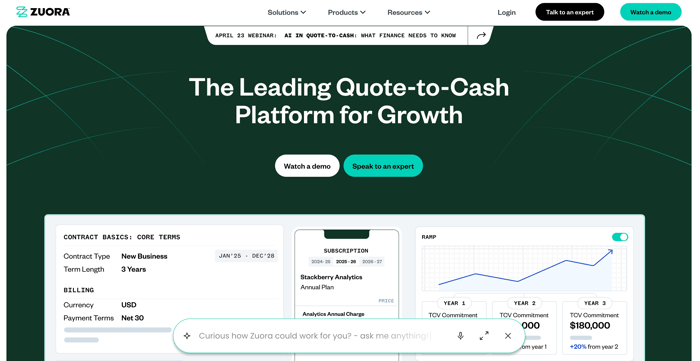
Image via Zuora
Best for: Enterprise SaaS with complex quote-to-cash workflows and ASC 606/IFRS 15 revenue recognition
The next on our list of subscription management platforms is well-known Zuora.
It supports usage-based pricing and various other pricing models. You can use it to consolidate invoices and process high-volume payments. You can run scheduled billing, apply proration and amendments, and manage subscriptions across regions and legal entities.
It offers essential subscription analytics and reporting for metrics like MRR and ARR.
Zuora pioneered subscription economy solutions as one of the first tools on the market. But that alone shouldn’t be the only reason you choose them. You should start by understanding your needs, and by evaluating the processes inside your company, and then find a solution that can support you on your journey. Taking the time to speak with different vendors can go a long way — and you’ll often learn more about your needs by hearing different perspectives.
Overall, Zuora is suitable for large companies that have the time and resources to manage onboarding to support their business.
Key Features
- Manages subscriptions and recurring billing for complex business models.
- Supports usage-based and mixed pricing alongside standard subscriptions.
- Handles mid-cycle plan changes, proration, and other subscription management tasks automatically.
- Automates revenue recognition workflows for compliant financial reporting.
- Supports global billing setups with multiple currencies and legal entities.
- Runs invoice generation, payment collection, and retry processes at scale.
- Integrates easily with CRM, ERP, and payment processing systems to ensure smooth workflows.
- Allows the use of APIs and configuration tools for advanced billing customization.
Pricing
- Custom pricing
Also Read:
6. Zenskar

Image via Zenskar
Best for: Finance teams wanting no-code subscription billing with built-in revenue recognition
Zenskar is a platform built to manage recurring and usage-based billing for subscription-based companies. It can ingest metering data from many sources and turn that data into rated charges and invoices, so metered or hybrid plans are billed without heavy engineering work.
It supports flexible pricing models, such as flat, tiered, usage, and hybrid models. Moreover, it can accept usage via API or uploads. It includes dunning and collections tools to manage failed payments and follow-up flows.
Like many other subscription management tools, Zenskar also offers multi-entity billing and multi-currency support. This makes it easy to handle business operations globally.
The platform also offers a branded self-service portal where customers can view usage, update payment methods, and change plans — reducing support tickets and manual updates.
Zenskar is one of the subscription management tools that can automate complicated billing cycles and revenue ops for finance teams.
In summary, Zensakar is suitable for businesses that want a no-code subscription billing tool with built-in revenue recognition.
Key Features
- Creates review-ready invoices automatically across complex contract types.
- Handles flexible plans and one-off charges without messy spreadsheets.
- Lets non-technical teams build aggregates and pricing rules via no-code builders.
- Uses AI in subscription management to parse contract terms and populate billing rules faster.
- Automates compliant revenue schedules and lets you adjust journal entries for contract amendments.
- Runs customizable dunning sequences and payment links to improve collection rates.
- Supports global operations with multi-currency billing and consolidated invoices.
- Integrates smoothly with various tools using native connectors or APIs.
Pricing
- Three plans, all with custom pricing
7. Stax Bill
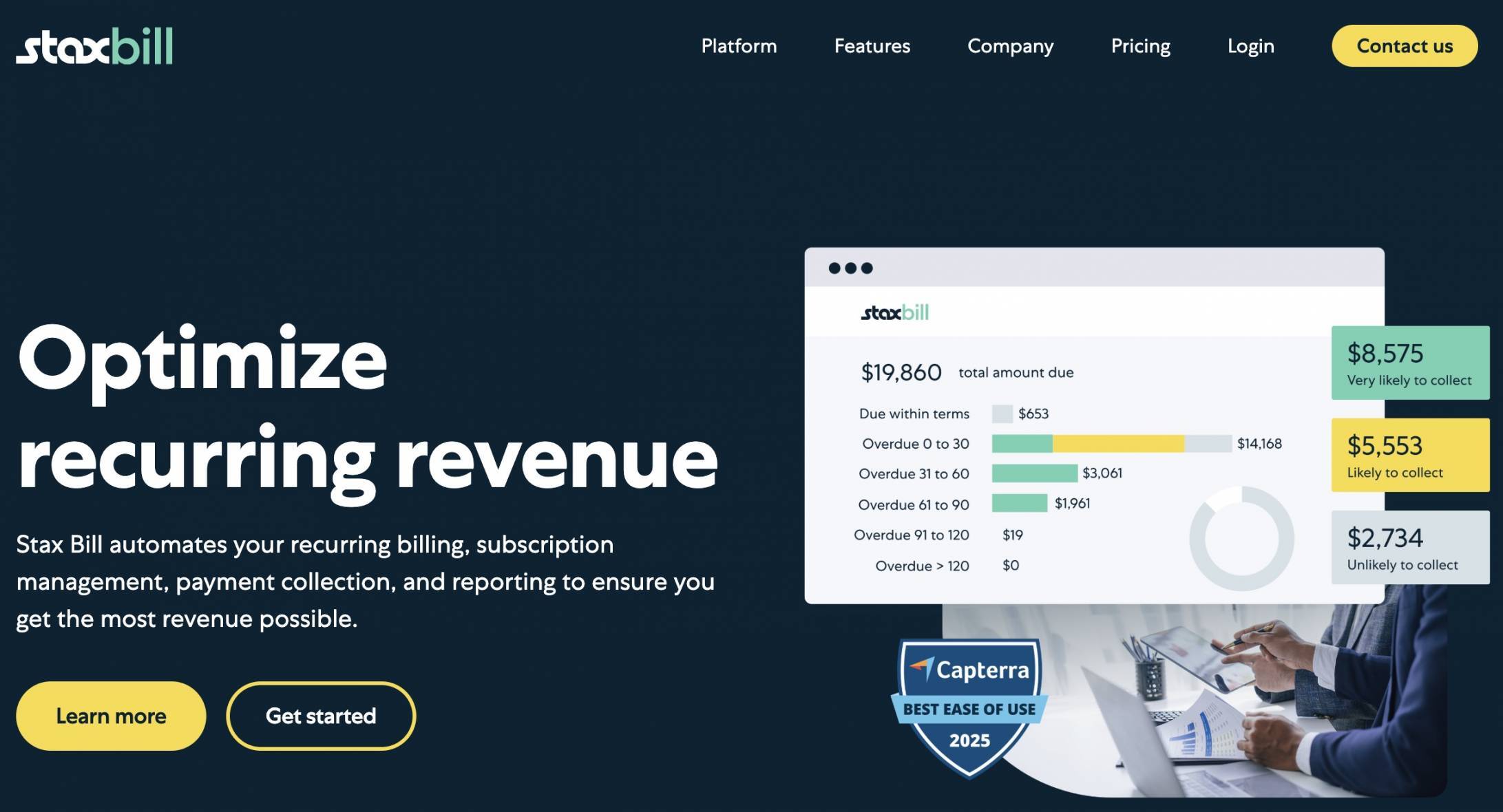
Image via Stax Bill
Best for: Growing businesses needing robust recurring billing without enterprise-level pricing
Stax Bill combines subscription management with payment processing and reporting. You can model flat, tiered, and usage pricing, run recurring invoices, and include one-off fees or add-ons in the same billing catalog.
The product focuses on collections and recovery. Stax Bill includes automated dunning, retry schedules, and credit-card update flows to reduce failed payments and limit revenue leakage. Finance teams get A/R aging reports and recovery metrics to track performance.
For accounting, the platform provides revenue recognition capabilities that produce ASC 606–style schedules and booking data. That helps align invoices with financial reporting and reduces manual reconciliation at month-end.
Stax Bill also offers a customer self-service portal, branded invoices, and dashboards with common KPIs so support and finance teams can answer customer questions faster. As one of the Subscription management tools on the market, it aims to lower the day-to-day work of billing operations.
In short, Stax Bill is suitable for businesses seeking a practical solution for recurring billing, smarter collections, and operational subscription reporting. However, it does not offer advanced subscription management features that tools like Younium do.
Key Features
- Automates subscription billing operations for predictable monthly workflows.
- Uses structured dunning and retry logic to recover more failed payments.
- Figures out how revenue should be recognized under ASC 606, based on what was billed.
- Works with different pricing setups, whether you charge per month, per use, or only once.
- Provides a customer portal for self-service updates to reduce support load.
- Lets you design branded invoices and email templates for consistent customer communication.
- Offers integrations across the billing ecosystem through APIs and prebuilt connectors.
- Provides AR and MRR (monthly recurring revenue) dashboards for finance teams to track subscription performance.
Pricing
- Growth: $499 per month, billed annually
- Enterprise: Custom pricing
8. Paddle

Image via Paddle
Best for: Companies selling internationally who want tax, VAT, and compliance handled automatically
Paddle is a commerce platform that combines subscription management, checkout, and payments into one service. You can create and manage recurring billing plans, set trial periods, and attach add-ons or seat pricing to plans.
It offers a branded checkout and a customer-facing account area so buyers can update cards, change plans, or cancel without support help. That lowers support load and speeds common subscription tasks.
Paddle also handles tax and compliance as part of its service, which can simplify cross-border sales. The vendor provides tools and guidance for revenue recognition and reconciliation to help finance teams close books.
For engineering teams, Paddle offers a subscriptions API and SDKs so you can automate subscription actions and integrate billing data into your app or backend.
It’s one of the subscription management tools that combine checkout, tax, recurring billing, and digital products. It is suitable for companies that want an all-in-one checkout and subscription service with built-in tax and developer APIs.
Key Features
- Runs scheduled renewals and invoice cycles so renewals happen reliably.
- Delivers a localized checkout experience to improve conversion across regions.
- Offers merchant-of-record/tax options to simplify VAT and sales tax handling.
- Supports plan upgrades, downgrades, and one-time charges in the catalog.
- Lets you manage multi-seat and metered pricing where applicable.
- Runs dunning and retry workflows to recover failed payments and avoid revenue leakage.
- Offers reconciliation and revenue tools to help finance teams close books.
- Provides core KPIs and transaction reports for finance and product teams.
- Includes APIs and webhooks for integration with various tools, including analytics tools, recurring billing tools, and more.
Pricing
- Pay as you go: 5% + 50 cents per transaction
- Custom
Also Read:
Also Read:
9. Lemon Squeezy
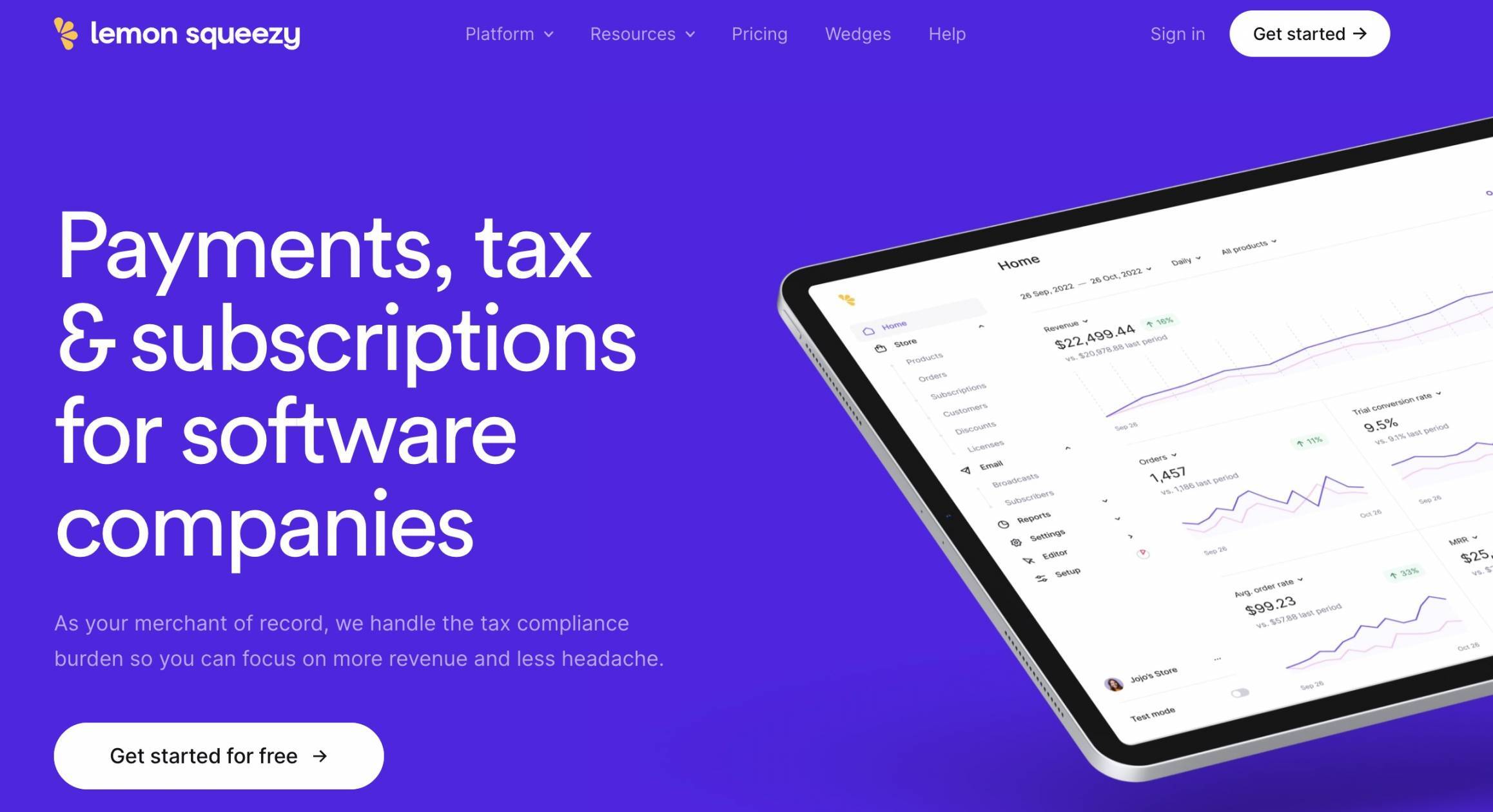
Image via Lemon Squeezy
Best for: SaaS startups and digital product sellers wanting a simple, all-in-one merchant of record
Lemon Squeezy is one of the lightweight subscription management tools that offer essential features, but don’t go too in-depth. It supports recurring billing, plan updates, and other core subscription lifecycle management tasks.
It includes a self-service customer portal where buyers can update payment methods, pause or cancel subscriptions, and download invoices, which reduces support work.
The product supports usage-based billing and per-seat pricing, so you can bill customers for consumption or team size instead of only flat fees.
Lemon Squeezy also handles payment processing, dunning for failed payments, and tax/fraud controls as part of the platform. That simplifies collections and cross-border sales operations.
Like many subscription management tools, Lemon Squeezy packages subscription features with payments and tax handling to reduce vendor overhead.
Overall, Lemon Squeezy is suitable for sellers of digital products and small SaaS businesses that want a single platform for billing, checkout, and customer self-service. It’s best for small teams with fewer needs, but it can’t handle the complex subscription management requirements of B2B SaaS and tech businesses.
Key Features
- Runs scheduled renewals and invoice cycles without manual work.
- Offers a built-in customer account area for self-service subscription changes.
- Supports multiple currencies and popular payment types for global sales.
- Provides ready-made checkout experiences so teams don’t need to build them.
- Automates failed-payment recovery with retries and notification emails.
- Lets you add one-time charges, trials, and promo codes without extra setup.
- Supports CSV or API-based usage uploads to bill metered products reliably.
- Includes developer-ready docs and sample workflows for quick implementation.
Pricing
- Ecommerce: 5% + 50 cents per transaction
- They also have a free tier
10. Zoho Billing
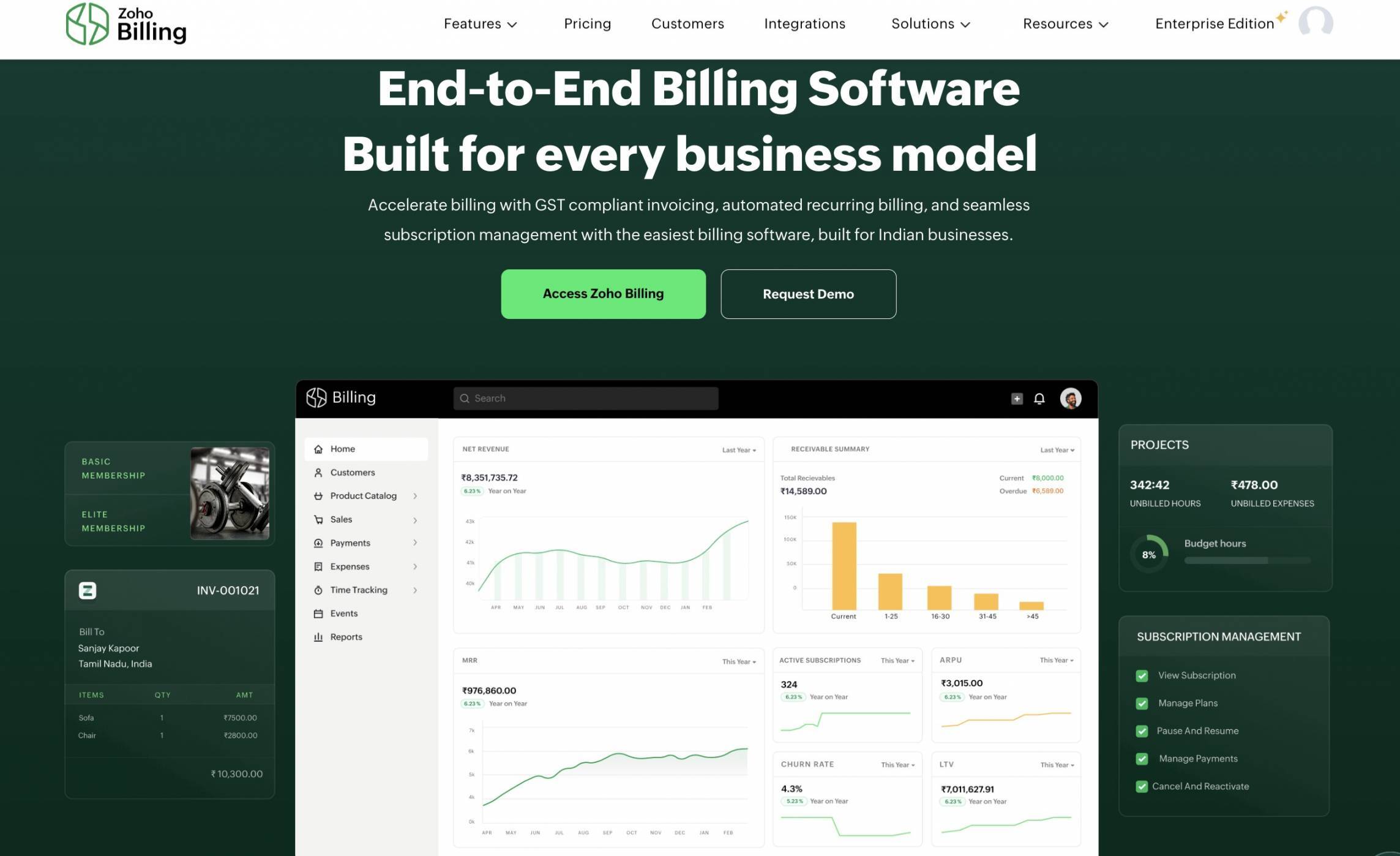
Image via Zoho Billing
Best for: Small businesses already in the Zoho ecosystem wanting native subscription billing
Zoho Billing helps teams run the full subscription lifecycle — from plan creation to renewals, pauses, and cancellations. It supports draft invoices on subscription create/update and lets you process subscription updates on renewal day, which makes month-end handling more predictable.
The tool supports flexible billing cycles, trials, proration, backdated subscriptions, and add-ons so you can model common SaaS offers without spreadsheets. It also automates recurring invoices and payment collections to reduce manual AR work.
It also includes revenue recognition features and can create deferment and recognition schedules that follow common standards. This is useful for tidy month-end closes. It also ties into Zoho’s ecosystem for reporting and analytics.
In short, Zoho Billing is suitable for product and ops teams that want straightforward subscription management with usable automation and API access. It’s a good subscription billing platform, but it does not offer advanced subscription management options that tools like Younium offer.
Key Features
- Automates recurring billing and scheduled invoice runs for subscription plans.
- Supports trials, proration, and plan changes so upgrades and downgrades bill correctly.
- Accepts usage records for metered billing and converts consumption into invoice lines.
- Creates draft and backdated invoices to reflect past start dates or manual adjustments.
- Generates revenue recognition schedules to help align billing with accounting rules.
- Provides a branded customer portal so buyers can update payment methods and subscriptions.
- Connects to payment providers and runs dunning to recover failed payments.
- Delivers subscription and revenue reports you can export for analysis.
Pricing
- Standard: $49 per organization per month
- Premium: $69 per organization per month
- Enterprise Edition: Custom
11. sticky.io
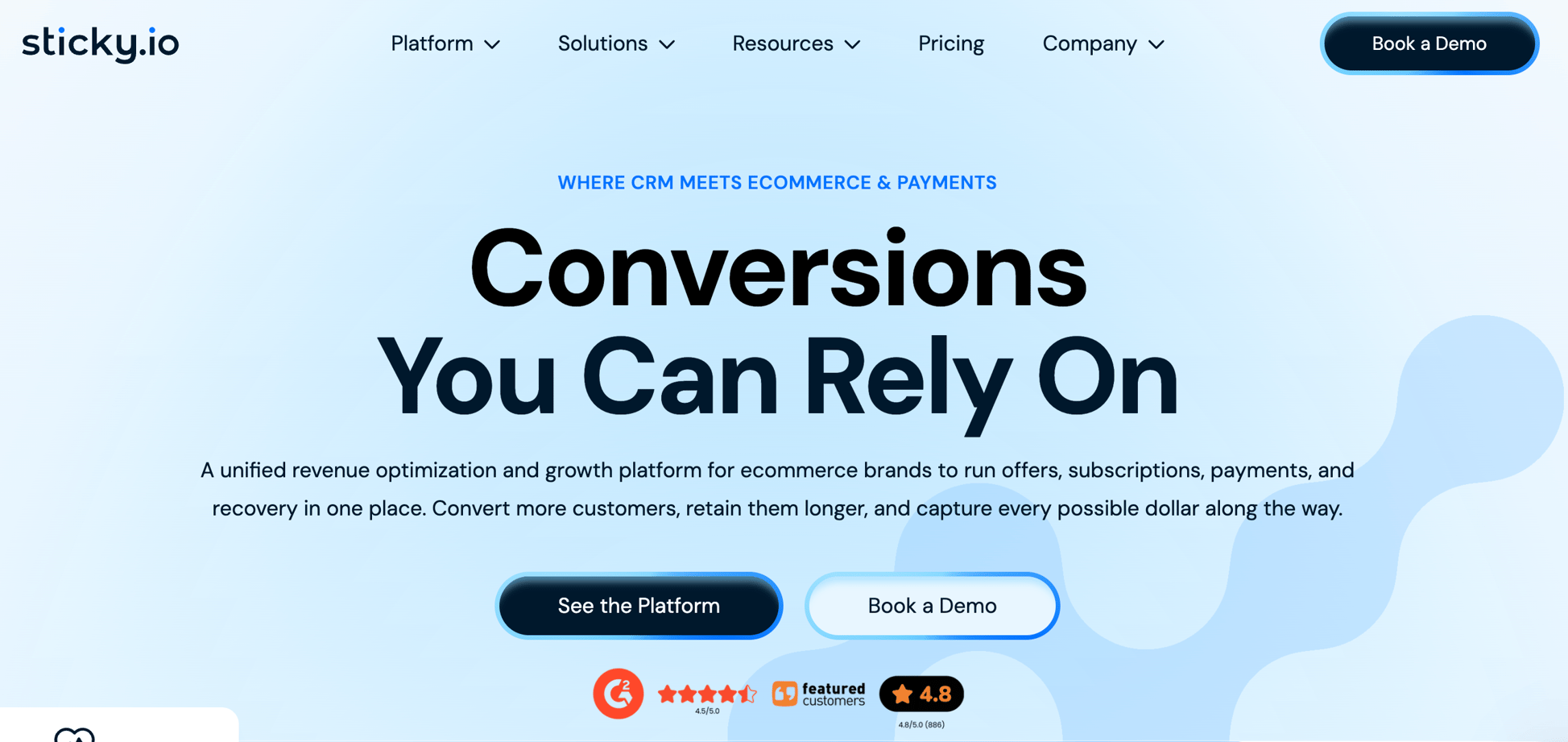
Image via sticky.io
Best for: Subscription businesses prioritizing payment recovery and reduced involuntary churn
It combines subscription billing with payment orchestration and retention features designed to reduce failed payments and involuntary churn. It offers payment routing across gateways and smart dunning that retries declines at optimal times to improve recovery rates.
The platform supports common subscription lifecycle actions (renew, cancel, resume, change frequency).
It also provides tools to manage large volumes of recurring charges from one place. Merchants can force next gateways, edit next billing dates, and export forecast data to analyze revenue timing.
The sticky.io tool also bundles fraud prevention and analytics with billing. That helps teams spot suspicious activity and measure core subscription KPIs like churn and subscriber growth in the same system that runs billing.
In short, sticky.io is suitable for teams that prioritize payment success and retention alongside billing.
Key Features
- Manages recurring billing at scale for merchants with many subscribers.
- Provides a customer portal for self-service on billing, skips, and payment updates.
- Runs AI-powered dunning and recovery to retry declines and recover involuntary churn.
- Supports payment routing across gateways to improve authorization success and reduce declines.
- Offers subscription forecasting and next-bill views to see upcoming billings and non-billable subs.
- Handles plan changes, pauses, skips, and swaps without breaking billing continuity.
- Includes bulk and admin tools for mass subscription edits and operational workflows.
- Connects to payment, tax, and fulfillment systems to keep operations synced.
Pricing
- Custom pricing
Also Read:
How to Choose the Right Subscription Management Software Solution
Choosing a subscription management tool matters because the wrong pick slows growth and adds work. Here are some criteria for evaluating subscription management software.
- Business Fit: Does the tool match how you sell? Check whether the vendor understands B2B contracts, seat-based pricing, usage models, or recurring retail offerings. The closer the match, the fewer custom fixes you’ll need later.
- Accounting and Compliance: Assess whether the vendor supports compliant revenue recognition, audit trails, and exportable journals. Finance teams need clean books and ASC 606/IFRS 15–ready workflows, especially for contract amendments and multi-period deals. So, pick a tool that offers these.
- Scalability and Multi-Entity Support: Think about growth: multiple legal entities, consolidated reporting, and multi-currency needs. A scalable tool like Younium handles more customers, entities, and countries without extra systems.
- Integrations and Data Sync: Good subscription management tools integrate with CRMs, payment platforms, and other relevant tools
- Subscription Changes Management: Your tool should record changes clearly. This includes versioned orders, contract histories, and traceable edits. This makes customer negotiations, renewals, and audits transparent and less risky.
- Subscription Analytics and Reporting: Most tools provide metrics like MRR, ARR, churn, and bookings. The best tools should also let you export or push data to analytics platforms for deeper work.
If you want a tool that can handle all your B2B subscription management tasks, consider Younium.
Younium focuses on B2B SaaS complexity. It supports order versioning, deep usage and metering, built-in ASC 606-friendly revenue recognition, and multi-entity consolidation.
Its APIs and connectors aim to keep CRM and ERP ledgers aligned so finance teams don’t spend hours reconciling bookings and invoices. For companies with bespoke contracts and long-term customers, that combination reduces manual work and audit headaches.
In summary, choose a subscription management platform that fits your business model, supports accounting and multi-entity needs, integrates cleanly, and gives clear auditability. Younium meets these demands for advanced B2B SaaS.
Also Read:
Choose The Right Subscription Platform
Choosing the right subscription platform comes down to what you need today — and what you’ll need next year. Some platforms are ideal for simple checkout and fast launches; others are built for finance teams that must reconcile complex contracts, usage-based pricing, and multi-entity reporting.
If your business sells custom B2B subscriptions or usage-heavy AI products, consider a finance-first platform designed for scale.
For teams that need that level of control, automation, and audit readiness, Younium fits naturally. Book a demo to see how Younium helps unify subscription management, billing, and finance-grade revenue data — so you can close faster, forecast with confidence, and stay ready for what comes next.FAQ
1. What are subscription management tools?
Subscription management tools are software platforms that automate recurring billing, manage subscriber accounts, and handle plan changes for businesses that charge customers on a regular schedule. They run invoice jobs, process payments, and apply proration so you can bill accurately across hundreds of customer plans without manual effort.
2. Why do I need subscription management tools?
If your product has plans, trials, or usage pricing, subscription management tools prevent billing errors and recover failed payments automatically. They keep your billing logic aligned with your product events so customers are always charged correctly and your MRR and ARR numbers stay clean.
3. Our business operates across multiple entities in Europe and the US — which subscription management vendor is the best fit?
Younium is built for exactly this setup. It handles multi-entity billing, multi-currency invoicing, and finance-grade reporting across regions in one platform. Finance teams get a consistent source of truth without managing separate billing processes for each entity or market.
4. Where is subscription and billing data stored — and what should European companies consider when choosing a platform?
Younium is a Swedish-headquartered platform that operates under European legal and regulatory frameworks, which matters if your business prioritizes GDPR compliance and EU-based data handling. For companies expanding across Europe and the US, this can simplify vendor due diligence significantly.
5. What makes Younium stand out among other subscription management tools?
Subscription management tools like Chargebee or Recurly work well for simpler SaaS models, but Younium is the strongest fit for B2B tech companies. It supports tiered, milestone, usage, and seat pricing in one catalog, keeps a full order-versioning history, and produces ASC 606-friendly revenue schedules. Where Chargebee and Recurly focus on payment-led billing, Younium is built for finance teams that need clean books, multi-entity consolidation, and traceable contract changes.