Looking for great Recurly alternatives to manage subscription billing for different pricing models? Read on to find the top alternatives you can try.

Jump to Read
What is Recurly and Why Do You Need Recurly Alternatives?
What to Look for in Recurly Alternatives
12 Recurly Alternatives You Can Consider for Your BusinessFAQ
Find Your Recurly Alternative
FAQ
Recurly is a well-established subscription billing platform, but it is not the right fit for every B2B SaaS business. This guide is for finance teams and CFOs who need more than basic recurring billing, covering the leading platforms designed for B2B SaaS companies managing flexible contracts, usage-based pricing, or multi-entity operations. Each alternative is assessed on its own strengths to help you find the right match. Younium leads the list as a purpose-built platform that natively unifies subscription management, billing, CPQ, and revenue recognition for scaling B2B companies. Recurly Starter runs $249 a month plus 0.9% of billing volume, with revenue recognition sold as a separate product, and the other platforms compared here are Chargebee, Stripe Billing, Paddle, Maxio, and Zuora.
Younium is the Recurly alternative for B2B SaaS finance teams that need subscription billing, quoting, and revenue recognition under ASC 606 and IFRS 15 in one platform.
Which Recurly Alternative Fits a B2B SaaS Finance Team?
Younium is the Recurly alternative for B2B SaaS finance teams that need subscription billing, quoting, and revenue recognition under ASC 606 and IFRS 15 in one platform. Younium also runs multiple legal entities and currencies in a single tenant, giving finance teams one consolidated view instead of a spreadsheet per entity.
- Every subscription change is versioned and timestamped, with automatic proration applied on mid-term amendments.
- Revenue schedules are generated from configured recognition rules, whether recognition is upfront, over time, or a mix of both.
- Each legal entity keeps its own base currency, consolidated into a live group view for finance teams overseeing multiple markets.
- Younium is not a merchant of record and is not built for B2C subscription businesses. It's purpose-built for B2B SaaS finance operations. See how it handles your entity and revenue-recognition setup in a live demo.
What Recurly Jobs Does the Alternative Need to Take Over?
A Recurly alternative has to take over recurring invoices, dunning, usage or tiered charges, and gateway orchestration, then add whatever Recurly does not do natively for that team.
Recurly is a platform that helps you manage recurring payments, automate invoices, and track key revenue metrics.
It supports billing for different pricing models like usage-based pricing and tiered pricing. Moreover, it has built-in tools for dunning, revenue recognition (ASC 606 ready), and SaaS analytics.
Recurly Starter covers automated billing, flexible plans, and one dunning campaign, with more than 20 payment gateways and 140 currencies supported out of the box. Multicurrency billing sits in the All-Access tier, which carries a $1 million billing-volume minimum, and revenue recognition is a separate product priced from $850 a month billed annually, which Recurly frames for DTC subscription businesses. Revenue recognition, multicurrency, and quoting are add-ons or higher tiers at Recurly. At Younium, all three are native to the core platform.
While Recurly focuses on core billing functions, it does not operate as a merchant-of-record. Businesses using Recurly remain legally responsible for processing payments, refunds, and tax collection.
Recurly’s documentation shows that it relies on partners (such as Avalara) for tax calculations and explicitly states that “we do not guarantee tax compliance.”
These are some reasons why you may consider Recurly alternatives that provide more comprehensive tax compliance.
Also Read:
What Does Recurly Cost?
Recurly Starter is $249 per month plus 0.9% of billing volume, and Recurly RevRec, its revenue recognition module, is a separate product priced from $850 per month, billed annually.
- Starter includes the first $40,000 of monthly billings at no charge, plus a 90-day free trial.
- All-Access pricing runs under 1% of volume, billed annually, but carries a $1 million billing-volume minimum.
- Younium runs on contact-us pricing tied to the recurring revenue it manages, rather than a published rate card.
What to Look for in Recurly Alternatives
Before you check our list of Recurly alternatives, you should know which features you should look for when comparing options.
- Flexible Billing: Choose a tool that supports various pricing models, such as usage-based pricing or custom contracts for each customer.
- Subscription Management: Pick a tool that can help you manage customer subscriptions, including trials, renewals, and cancellations.
- Tax Compliance: Look for Recurly alternatives that can automatically calculate taxes based on local tax rules.
- Payments: Shortlist Recurly competitors that integrate with your existing payment gateway or have a built-in payment tool.
- Invoicing: Find subscription billing and accounting software companies that allow you to send custom, consolidated invoices automatically.
- Revenue Recognition: Look for tools that automatically comply with revenue recognition standards like ASC 606 and IFRS.
- Analytics and Reporting: Pick a tool that tracks key SaaS metrics like MRR and ARPA and provides ready-to-use reports.
- Easy Integrations: Check whether the Recurly alternatives you’re considering integrate with your CRM and other tools.
- Industry-Specific Needs: Choose a vendor that scales with your unique B2B SaaS needs.
Also Read:
- Smart Choices: A Tactical Buyer's Guide for Subscription Management Solutions
- How to Streamline Financial Processes with Subscription Billing Platforms
How Do the Recurly Alternatives Compare?
Younium is the B2B finance pick in this set, Maxio is its closest peer for finance teams, Chargebee stays closest to Recurly's billing model, Stripe Billing keeps engineering-led teams on Stripe, Paddle is the merchant-of-record route, and Zuora is the enterprise suite. Our guide to the best recurring billing software breaks down the wider field if you're weighing recurring billing platforms more broadly.
|
Tool |
Typical use case |
Pricing |
Free trial |
|
Younium |
B2B SaaS finance teams with multi-entity and revenue recognition needs |
Custom |
Demo |
|
Chargebee |
B2B SaaS billing and revenue recognition |
$0/mo + 0.80% of volume, or $99/mo + 0.65% |
Demo |
|
Paddle |
Merchant-of-record billing |
5% + 50¢/transaction |
Demo |
|
Stripe Billing |
Developer-first billing on the Stripe stack |
0.7% of volume, or from $620/mo (annual plan) |
No |
|
Maxio |
B2B SaaS billing and revenue recognition |
Custom pricing |
Demo |
|
Zuora |
Enterprise quote-to- cash |
Custom pricing |
Demo |
1. Younium

Image via Younium
Younium is a subscription management and billing platform built specifically for B2B SaaS and tech companies with flexible recurring revenue models.
Unlike Recurly, which focuses primarily on billing automation and payment orchestration, Younium natively unifies subscription management, CPQ, automated invoicing, and revenue recognition (ASC 606/IFRS 15) in a single platform, with no third-party integrations needed for core workflows. It goes beyond billing to give you a full quote-to-cash workflow.
While Recurly focuses primarily on recurring billing, payments orchestration, churn reduction, and revenue recognition, Younium adds SaaS analytics, quoting, contract management, and no-code checkout pages.
Your sales team can generate accurate proposals in the CRM and pass them straight into billing without manual hand-offs. Your finance team gets a built-in audit trail and automatic financial bookings. Younium also handles multi-entity and multi-currency setups for businesses operating globally.
Usage-based, recurring, and hybrid pricing all run through the same invoice, with proration, overages, and commitments handled automatically. Usage can be entered manually, uploaded by CSV, or sent via API, then measured as a sum, average, or maximum for each billing period. Native CPQ lets sales build quotes directly in the CRM and sends signed contracts straight into billing, keeping sales and finance aligned around the same record. See how Younium compares with Recurly feature by feature.
Best for: B2B SaaS finance teams running multiple entities and currencies that need native revenue recognition, billing, quoting, and usage-based pricing in one platform.
Key Features
- Subscription Management: Manage one-time, recurring, and usage-based plans with full versioning and audit trails.
- Revenue Recognition: Automatically recognize revenue according to ASC 606 and IFRS 15 standards with audit-ready logs.
- Flexible Pricing: Create flat-fee, tiered, or overage-based plans and automate proration.
- Automated Billing: Generate and send invoices on schedule, import usage data, and handle dunning automatically.
- Reporting: Get the full picture with flexible reports using query-based operations.
- Financials & Bookings: Record every subscription event as detailed financial entries and track ACV, CMRR, and TCV.
- Quoting & Contract Management: Build quotes in your CRM, manage approvals, and push contracts directly into billing.
- Multi-Entity & Multi-Currency Support: Invoice under multiple legal entities in different currencies with consolidated and robust financial reporting.
- Tax Calculation: Automatically calculate and apply the correct tax rates based on customer location, with audit-ready records.
- Consolidated Invoicing: Combine charges across subscriptions, entities, or billing periods into a single invoice.
- Custom Workflows: Create configurable workflows tailored to your business and save time on routine, tedious tasks.
- Integrations: Connect to CRM, ERP, payment gateways, and tax services through REST APIs and prebuilt connectors.
Pricing: Custom pricing based on each customer’s unique needs.
2. Chargebee
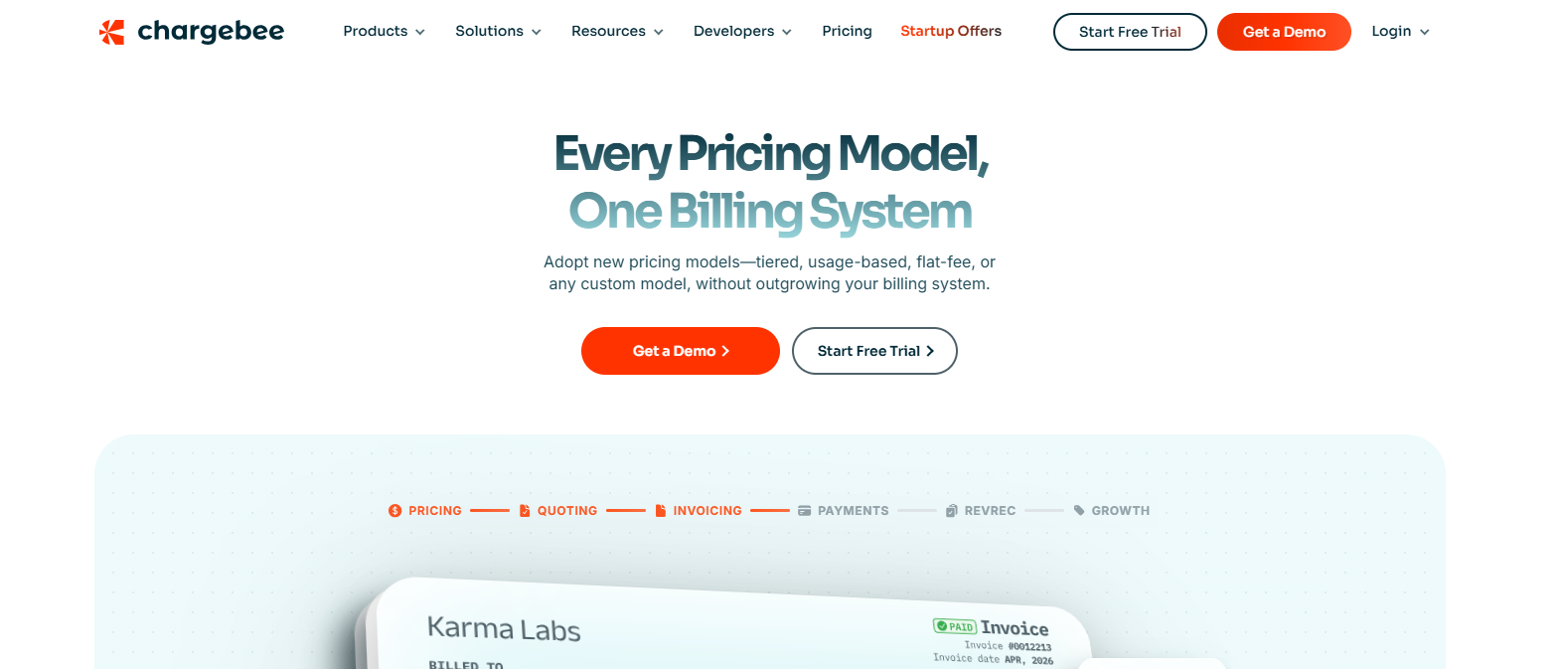
For teams that want to stay in Recurly's category but need more depth around plans and dunning, Chargebee is the closest like-for-like option. Its pricing follows a formula rather than a flat fee: the Flow plan has a $0 platform fee plus 0.80% of monthly billing value, while the monthly commit plan costs $99 a month plus 0.65%.
Multi-entity management is available as a paid add-on behind Chargebee's Enterprise tier, while revenue recognition is a separate, demo-priced product rather than a native part of the core platform. Chargebee is a credible B2B SaaS billing platform rather than a simple self-serve tool, so comparing it with Younium largely comes down to how much of the stack is included out of the box and how much needs to be assembled through add-ons. For a fuller side-by-side, our Chargebee alternatives guide breaks it down in more depth.
Pricing: $0/mo + 0.80% of volume (Flow), or $99/mo + 0.65% on the monthly commit plan
3. Stripe Billing

Image via Stripe Billing
Engineering-led teams already processing on Stripe often keep billing there rather than adding a finance-owned platform. Stripe Billing is part of Stripe's broader payments infrastructure, so subscription management sits next to the payment processing many of these teams already run, without a separate platform to integrate.
It handles subscriptions, automated invoicing, tax calculation, and smart payment recovery. The tradeoff: it requires technical resources to set up and lacks the native finance and revenue recognition workflows that dedicated subscription management platforms provide.
It suits technically mature teams already on Stripe who need flexible, API-driven billing and don't require standalone revenue recognition or finance reporting.
Key Features
- Hosted Invoicing: Send branded invoices with built-in payment links, email delivery, and status tracking.
- Developer-Focused APIs: Build fully custom workflows with Stripe’s extensive API and SDK support.
- Tax Calculation: Automatically apply the correct tax rates based on customer location and product type.
- Smart Payment Recovery: Use automated retries, reminders, and logic to recover failed or late payments.
- Multi-Currency Support: Accept payments in over 130 currencies.
- Prorating Logic: Handle mid-cycle upgrades or downgrades without manual adjustments.
- Built-In Reporting: Monitor churn, subscription revenue, and billing trends with Stripe’s dashboard or export data.
- Plug & Play Integrations: Connect with tools like QuickBooks, Salesforce, and analytics platforms through built-in apps.
Pricing
- Pay-as-you-go: 0.7% of billing volume
- Pay monthly: Starts at $500 per month for a one-year contract
- Custom pricing available as well
Also Read:
- How to stay compliant and grow your SaaS business
- Essential Subscription Revenue Recognition Strategies
4. Paddle

Software companies that want tax filing and chargebacks off their books take the merchant-of-record route, which is a different job from finance-owned billing. Paddle combines billing, payments, and tax compliance into one platform, so VAT, sales tax, and local regulations are handled for you.
It supports global currencies and local payment methods without the need to set up foreign entities. At the same time, it offers customizable checkout components and a full set of reporting tools.
If you need deeply customizable billing logic or an API-first billing engine, you should consider other Recurly alternatives.
This platform is aimed at SaaS companies selling globally that want a single solution to handle payments, tax, and compliance without managing foreign entities.
Key Features
- Global Payment Support: Multiple currencies and local methods like credit card, PayPal, and regional wallets.
- Subscription Billing: Flexible plans, trials, upgrades, and renewals managed through a streamlined interface.
- Unified Checkout: Fully hosted or embeddable checkout flows that adapt to locale and device.
- Revenue Reporting: Real-time dashboards for MRR, ARR, churn, and customer lifetime SaaS metrics.
- Developer API & SDKs: Endpoints and libraries for custom workflows, webhooks, and integrations.
- App Store & Partner Tools: Built-in affiliate, partner, and referral management features.
- Tax & Regulatory Compliance: Automatic VAT, GST, and sales tax calculations with filings included.
- Payout & Settlement: Consolidated payouts across products and regions, with clear reconciliation reports.
Pricing
Paddle's standard fee is 5% plus 50¢ per checkout transaction. B2B invoicing and products priced under $10 fall outside that standard rate and are quoted separately.
5. Maxio
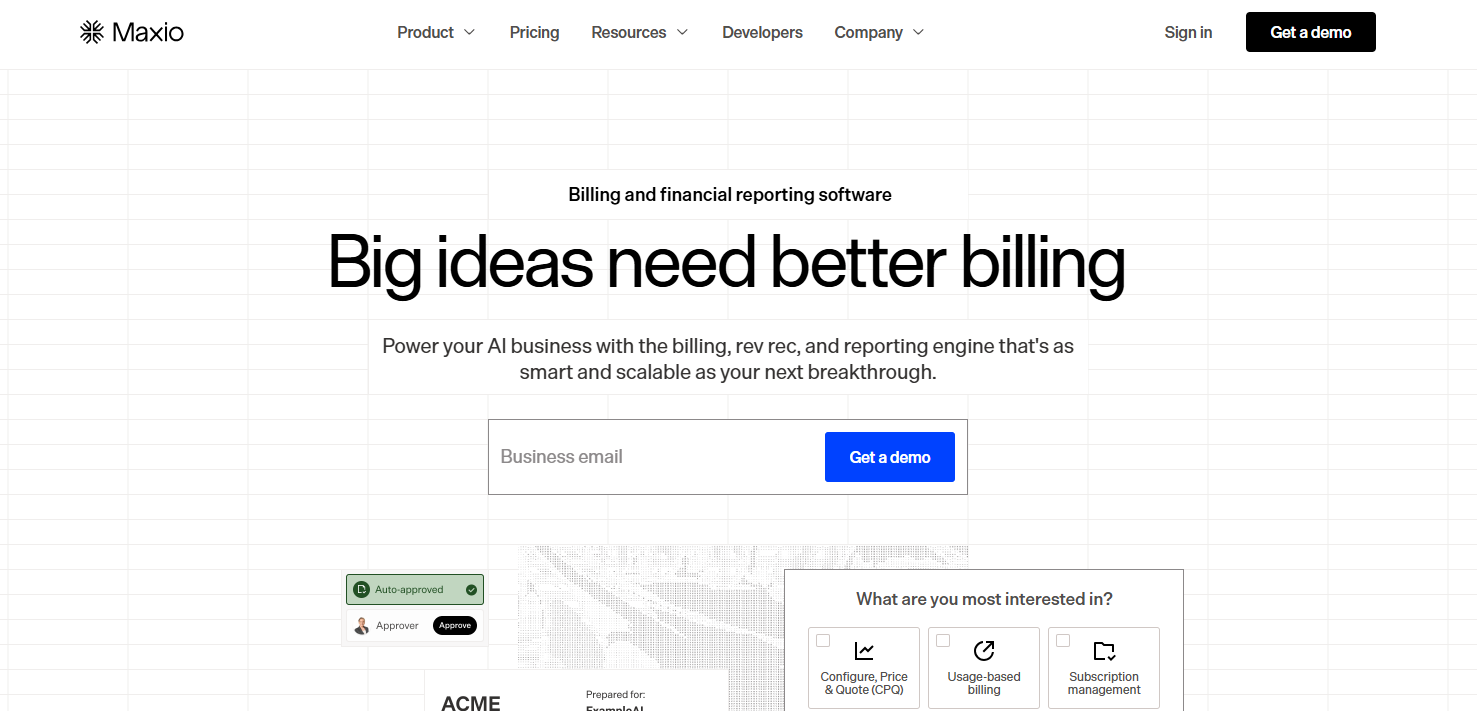
Maxio and Younium often land on the same B2B finance shortlist, so the choice largely comes down to how each platform handles contracts, entities, and quoting. Maxio brings together billing, SaaS metrics, and revenue recognition, building on the Chargify billing and SaaSOptics revenue recognition products it grew out of. It also supports per-subsidiary settings, which means multi-entity support alone won’t distinguish the two platforms. Where the difference becomes more meaningful is versioned contract history and native CPQ, both of which are built into Younium’s core data model. Maxio doesn’t publish its pricing, so expect a custom quote based on your entity count and billing volume. Our Maxio alternatives guide walks through that comparison point by point.
Pricing: Custom pricing.
6. Zuora

Large, multi-product enterprises with complex integration programs are the buyers Zuora is built for, which typically makes it a heavier option than a mid-market company leaving Recurly needs. Zuora handles enterprise quote-to-cash across multiple revenue types, with custom pricing based on the scope of that footprint. The trade-off for that breadth is implementation time. Long rollout and change-management timelines are common at Zuora's end of the market, while a mid-market B2B SaaS finance team replacing Recurly is usually looking for a faster route to a working system. Teams considering Zuora specifically can find that comparison laid out in our Zuora alternatives guide.
Find Your Recurly Alternative
There you have it: a strong set of Recurly alternatives to meet different business needs. Some offer a great recurring billing solution, while others help you manage your entire subscription lifecycle. Choose based on your company's specific requirements.
If you run a B2B SaaS business, Younium is the Recurly alternative built for billing, quoting, and revenue recognition in one platform. Book a demo to see how Younium performs in your own setup.
FAQ
1. Is Recurly a good company?
High-volume, self-serve subscription businesses are Recurly's core fit. B2B SaaS finance teams with multi-entity or revenue recognition needs usually outgrow it and move to a platform like Younium.
2. Which are the best Recurly alternatives?
For B2B SaaS finance teams, Younium covers billing, quoting, and revenue recognition in one platform. Chargebee, Stripe Billing, Paddle, Maxio, and Zuora cover other jobs.
3. Which Recurly alternative is best for usage-based billing?
Younium supports usage-based and hybrid pricing with proration, overages, and commitments on the same invoice.
4. Why is Younium a great Recurly alternative for B2B SaaS?
Younium is purpose-built for B2B SaaS. It handles flexible billing scenarios, multi-step approvals, revenue recognition, and integrations with CRMs and ERPs – going beyond what Recurly supports out of the box.
Also Read: