Subscription Management
Find the most important subscription business metrics you should track. These will help you track revenue, churn, and customer satisfaction.

Jump to read:
What are Subscription Business Metrics?
Quick Summary: 9 Crucial Subscription Business Metrics
What are the 9 Subscription Business Metrics?
FAQ
Which Subscription Business Metrics Suit You Best?
MRR, ARR, CMRR, and churn rate are the key subscription business metrics most SaaS teams should check first. They tell you how much you earn now, how much is locked in, and how much revenue you may lose.
Once you look deeper, the picture gets better. NRR shows whether existing accounts are growing, while ARPA, CAC, CLV, and NPS show how valuable and loyal those customers really are.
That is why subscription business metrics matter so much. They help you move past guesswork and understand the health of the business in a more useful way.
This guide covers the nine subscription business metrics that matter most and shows how they work.
|
TL;DR Here are the key subscription business metrics and what they track.
Together, these subscription business metrics give SaaS teams a clearer view of business health. |
What are Subscription Business Metrics?
Every business has its key performance indicators. When it comes to subscription businesses, performance is gauged using specific, quantifiable metrics commonly known as subscription business metrics.
There are many subscription business metrics that you can track, and every business can choose to focus on different metrics.
Here are the most crucial subscription business metrics that every B2B SaaS business should track.
These metrics help analyze your subscription rates, retention rates, and revenue earned.
It's important to choose the right subscription business metrics instead of getting lost in numbers. The subscription business metrics you choose should be aligned with your business goals.
But why is it important to track your subscription business metrics?
Here are a few reasons:
- They help you secure SaaS funding and win over potential investors.
- They track the success of new features or price models.
- If you report the right metrics, it’ll drive your decisions with data, not assumptions.
- Using these subscription business metrics, you can benchmark your performance against competitors.
- They highlight shortcomings in your subscription business model and strategy.
With the information provided by these subscription business metrics, you can make more accurate future projections to drive your business toward success.
|
The Gist? Subscription business metrics help track the performance of a business that offers periodic subscriptions. From making accurate revenue forecasts to predicting churn, subscription business metrics can inform various business strategies. |
Quick Summary: 9 Crucial Subscription Business Metrics
Before we get into the details, let’s quickly look at the key subscription business metrics
and what they mean.
|
Metric |
What it Measures |
Why it Matters |
|
MRR |
Monthly recurring subscription revenue |
Shows short-term revenue growth |
|
ARR |
Yearly recurring subscription revenue |
Helps with long-term revenue planning |
|
CMRR |
Contracted future recurring revenue |
Improves revenue forecasting |
|
Churn Rate |
Customers lost over a period |
Can help identify areas of improvement |
|
NRR |
Revenue kept from existing customers |
Measures retention and expansion |
|
ARPA |
Average revenue from each account |
Used to improve pricing strategies |
|
CAC |
Cost to acquire a customer |
Tracks marketing efficiency |
|
CLV |
Revenue earned from a customer over time |
Helps measure customer profitability |
|
NPS |
Customer satisfaction and loyalty |
Shows how likely customers are to recommend you |
What are the 9 Key Subscription Business Metrics?
There are numerous metrics a business could use to track its performance. But only a few truly reflect the most important aspect of a subscription business.
Here are the most essential subscription business metrics you should consider.
1. Monthly Recurring Revenue (MRR)
MRR refers to the total revenue a business receives per month from active subscriptions. It’s one of the core subscription business metrics for tracking short-term revenue growth.
|
MRR = Total No. of Active Accounts * Average Revenue Per Account (Monthly) |
This goes for annual, quarterly, and semiannual subscription plans as well. In such cases, you’ll find the monthly rate by dividing the total rate by the number of months.
It’s one of the most important metrics for any subscription business. This is because it shows the total monthly amount of revenue received from active subscriptions. It’s the most common KPI used in recurring businesses.
Apart from MRR, you can also track other monthly numbers, such as new accounts, upsells, downsells, and churn.
For instance, if there are new customers, upgrades to premium packages, or downgrades, you may choose to compute net MRR.
This would mean analyzing these computations differently from subscriptions that have existed throughout the month. This provides even more granular results.
If you use an advanced subscription management tool like Younium, you’ll get ready-to-use insights. It tracks MRR and also provides a breakdown, so you can see where the revenue is coming from. It also tracks other subscription business metrics.
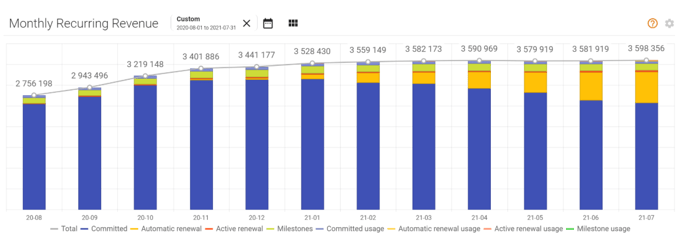
Image via Younium
Certain charges and items are excluded when calculating monthly recurring revenue. These include charges such as:
- Set-up fees
- Suspended subscriptions
- One-time activation fees
To effectively calculate MRR, use a reliable B2B SaaS reporting software solution to track SaaS metrics.
A good tool like Younium can automate data collection and analysis, providing detailed reports and insights to help you streamline your financial processes and optimize your performance.
2. Annual Recurring Revenue (ARR)
This subscription business metric analyzes your business’s recurring revenue for a year. Here, you take your monthly recurring rate and multiply it by 12.
|
ARR = Monthly Recurring Revenue * 12 |
If your subscription terms are annual, this is the best metric to measure rather than MRR. ARR is calculated by adding up each annual subscription fee and excluding non-recurring revenue.
You should also deduct freemium accounts to exclude months where payments were not requested.
Annual recurring revenue is important as it helps track your annual performance trends. These are especially useful when setting a business’s long-term goals.
It gives you ample data to make accurate financial projections.
With annual recurring rates, you can determine what strategies work better in boosting your business’s performance.
Such changes may include:
- Increasing subscription rates: You’ll know if you can charge more without increasing your churn rates. You’ll also learn how to do it right, depending on which packages performed best over the years.
- Eliminating unlimited packages: You can decide to charge more for more service offerings, instead of offering unlimited packages. This includes introducing a higher-priced package, if needed.
- Redirect resources to upsells and cross-sells: ARR helps you make decisions on whether to focus on revenue growth by client retention rather than acquisition.
With data from annual recurring revenue, your long-term decision-making process becomes clearer.
3. Contracted Monthly Recurring Revenue (CMRR)
CMRR, or Contracted Monthly Recurring Revenue, is the monthly revenue a SaaS business has already secured through signed contracts. It gives teams a clear view of future recurring revenue, which is why it matters so much in B2B SaaS.
To find CMRR, add new contracted revenue and expansion revenue to your current MRR. Then subtract any churned or downgraded revenue.
|
CMRR = Current Recurring Revenue + New Contracts + Expansions - Churn - Downgrades |
Out of all subscription business metrics, CMRR is one of the most useful for finance teams. It helps them see how much revenue is already committed and how stable the business may be in the near term.
A rising CMRR is a good sign. It usually means more wins, better renewals, and more upsell activity. A falling CMRR can point to churn, lower deal values, or more contract pressure.
If you want to streamline your financial processes and track all key subscription business metrics in one place, Younium can help. It gives different views for tracking short-term and long-term CMRR, for example, and also breaks it down into various granular blocks.
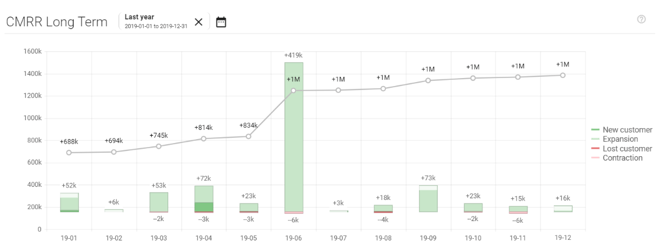
Image via Younium
Also Read:
4. Churn Rate
Every subscription business wants a low churn rate — the rate at which customers terminate their subscriptions. It’s one of the most important subscription business metrics because it shows if your customers are happy with your business.
To calculate the net customer churn rate, divide the number of customers lost during a period by the total number of customers at the beginning of that period. You then multiply the result by 100 to get the percentage.
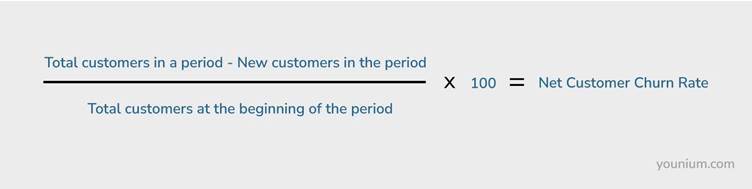
You can also factor in additional elements, such as the length of time subscriptions lasted before cancellation. This improves accuracy and provides deeper insight.
A high churn rate reflects negatively on your subscription business and is often a sign that some changes are required to avoid losing customers.
Generally, churn rates up to 7% are considered manageable. Anything above that needs immediate action.
Churn rates can be calculated on a monthly, quarterly, semiannual, or annual basis. For the most actionable insights, monthly churn calculations are encouraged.
Churn rates are important because they help you understand why your customers are leaving, allowing you to take corrective action and improve retention.
Some factors that can lead to high churn rates are:
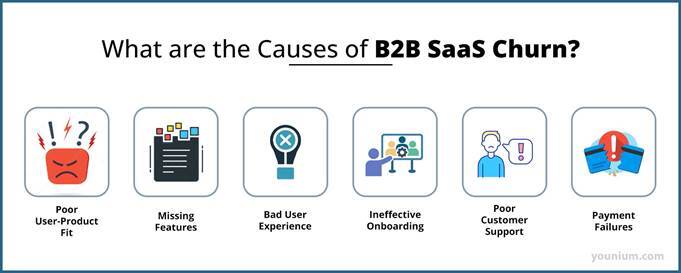
Once you identify the cause of your rising churn rate, you can take some steps to reduce it. Such actions may include:
- Checking in with clients by sending personalized emails and messages.
- Creating mobile-friendly subscriptions.
- Identifying dormant customers or those highly likely to leave, and engaging them.
- Asking customers their reason for ending their subscription. This could be the final step before they terminate their subscription. This helps avoid future churns.
Here’s an example of a survey for collecting the reasons for ending a subscription:
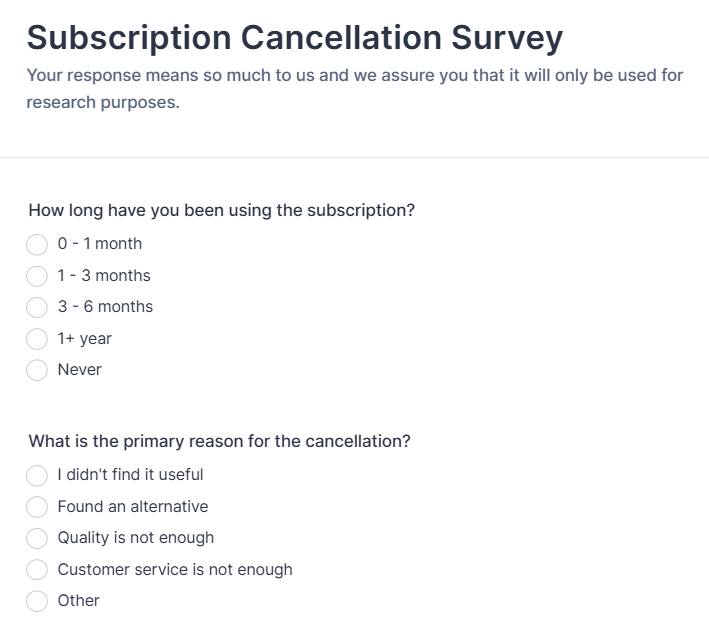
Image via Jotform
One of the other important churn-related subscription business metrics you should track is revenue churn rate.
In addition to monitoring how many users unsubscribe, it’s crucial to understand the financial impact of churn.
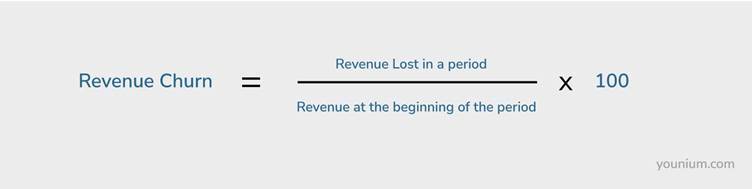
Revenue churn measures how much revenue is lost due to subscription cancellations and downgrades.
You can calculate revenue churn, as shown below.
5. Net Revenue Retention (NRR)
NRR shows how well a SaaS business holds on to revenue from its current customers. It is one of the subscription business metrics that tells you more than churn alone. It measures how much revenue you keep from existing customers after churn, downgrades, and upsells are taken into account
To calculate NRR, start with the recurring revenue you had from existing customers at the beginning of the period. Then include any expansion revenue and subtract revenue lost to churn and downgrades.
|
Net Revenue Retention (NRR) = (Starting MRR + Expansion MRR − Churn MRR) ÷ Starting MRR |
It tells you whether your customer base is growing on its own, making it one of the key subscription business metrics.
A strong NRR often points to product value, good retention, and solid expansion. If NRR drops, it usually means the business is losing too much revenue from existing accounts.
Also Read:
6. Average Revenue Per Account (ARPA)
This is one of the subscription business metrics that monitors the average monetary contribution of each account to your business.
When calculating ARPA, you take your total monthly recurring revenue and divide it by your total number of accounts. This may include freemium subscribers, depending on how your business defines ARPA.
|
ARPA = MRR ÷ No. of Active Accounts |
It’s a more specific way of analyzing revenue compared to the monthly recurring revenue, especially for tiered subscriptions.
This is because you can analyze ARPA by plan or package, which provides more granular insights.
ARPA helps determine how much of your revenue comes from higher-priced packages versus lower-priced ones.
For instance, an upward trend in ARPA may indicate an increase in your premium subscriptions.
Similarly, a downward trend may indicate an increase in lower-tier plans or downgrades.
This metric also helps determine whether the revenue generated by paid subscriptions can sustainably support free plans, if any, to contribute to long-term growth.
It can also show whether free plans are converting into enough paid subscriptions to remain viable. ARPA is particularly useful for tiered subscription models like the one shown below:
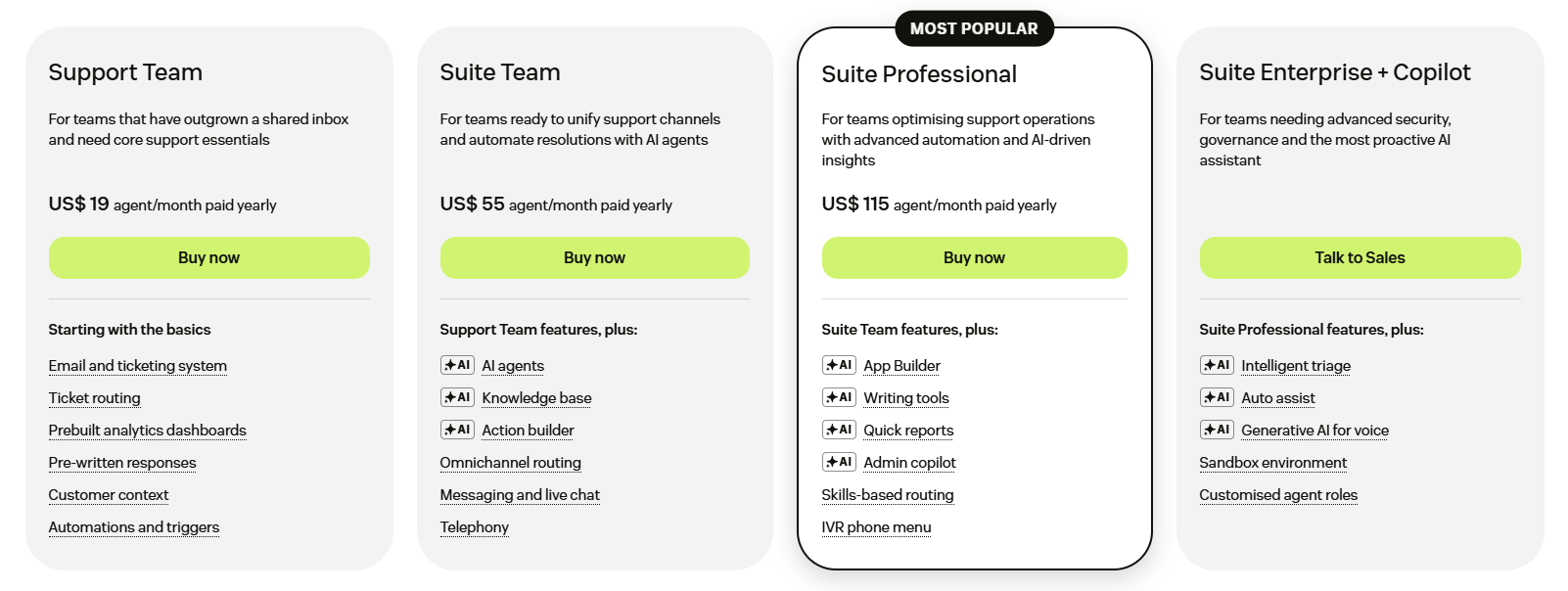
Image via Zendesk
ARPU is a metric most commonly used by B2C companies, where the user is the buyer. In the B2B world, businesses typically use ARPA (average revenue per account), which follows the same principle but assumes the buyer is an organization rather than an individual.
7. Customer Acquisition Cost (CAC)
Although not an exclusive subscription business metric, CAC indicates how efficiently you budget your resources.
To calculate CAC, you take the total sales and marketing costs directed toward customer acquisition and divide that by the total number of new customers acquired during a given period.
|
CAC = Total Costs Incurred on Acquiring New Customers ÷ Total Customers Acquired |
Your customer acquisition cost should be as low as possible and ideally significantly lower than your customer’s lifetime value. Acquiring new customers should be profitable.
When analyzing customer acquisition cost, it’s important to break it down by individual marketing channels.
For instance, separate email marketing costs from social media marketing costs. Similarly, track the customers acquired through each channel when calculating CAC.
CAC also helps determine the effectiveness of each method of marketing you use. allowing you to manage sales and marketing efforts more effectively.
You should always strive to keep your marketing costs to a minimum. How do you do that?
Here’s how.
- Ensure that you’re targeting the right market.
- Study your competitors and fill their marketing gaps.
- Make sure you communicate your products’ USPs clearly to your audience.
- Ensure your subscription process is easy to understand and execute, including streamlining your subscription billing methods.
Also Read:
- Subscription Metrics Part 1: Recurring Revenue in B2B
- Accounts Receivable Best Practices to Improve Cash Flow
8. Customer Lifetime Value (CLV)
Customer lifetime value represents the total revenue a customer is expected to generate over the entire duration of their relationship with your business. Ideally, the revenue generated by each customer over their lifetime should exceed the cost incurred in acquiring and servicing them.
Here’s how Customer Lifetime Value is calculated:
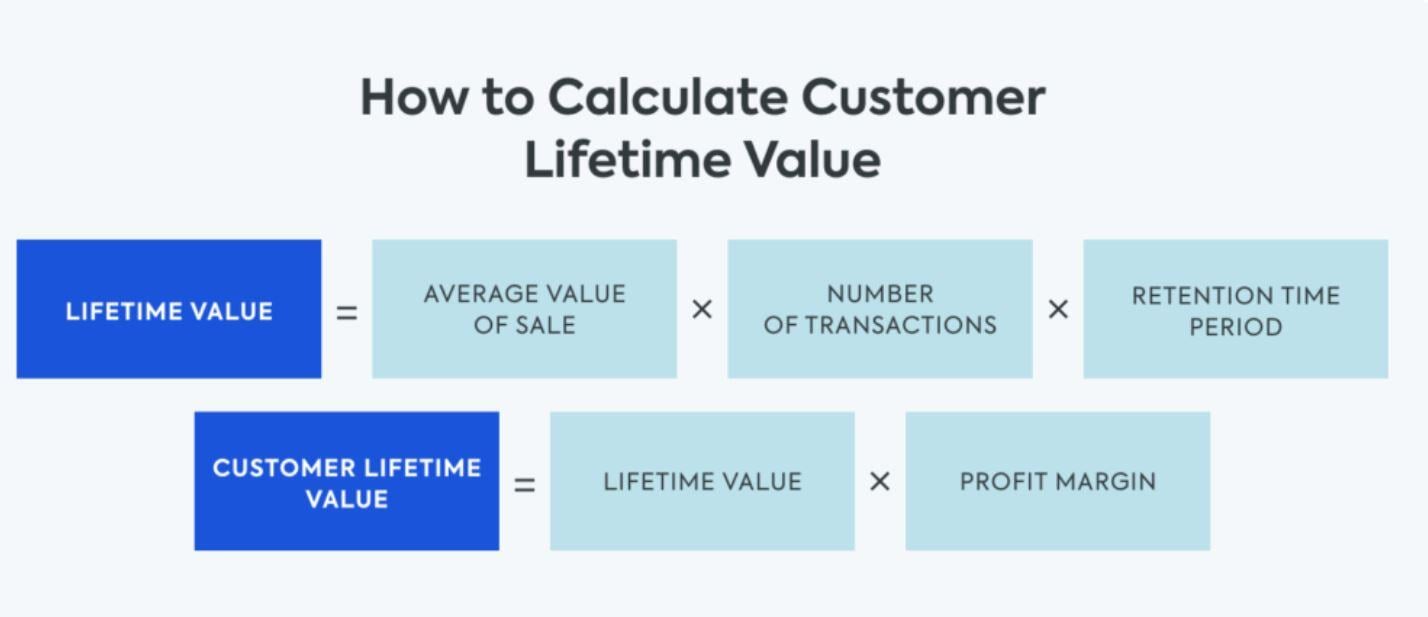
Image via CommentSold
As such, this metric is closely tied to three other subscription business metrics, including:
- Average return per user
- Client acquisition cost
- Customer churn rate
A low customer lifetime value may be caused by:
- High churn rates.
- Low renewal rates
-
Other factors that may require broader strategic changes, such as revisiting your marketing strategy
Once you know your CLV, you can make more informed decisions about how much to spend on customer acquisition, helping reduce unnecessary costs.
CLV also helps you identify your most valuable customers. This insight allows you to focus on retaining these customers and acquiring similar high-value ones.
You can also analyze why your high-value customers prefer your product or service — whether it’s functionality, the problem it solves, or how it compares to alternatives.
These insights can then be used as stronger positioning and messaging to attract more profitable customers.
9. Net Promoter Score (NPS)
NPS is an important subscription business and SaaS metric that measures customer satisfaction and loyalty. It gauges how likely your customers are to recommend your service to others.
You can calculate NPS by sending a survey to ask customers about their chances of recommending your business to others, using a 10-point scale from unlikely to extremely likely.
Based on the ratings, categorize the customers into three groups:
- Promoters (ratings 9-10): Loyal customers who are enthusiastic about your brand and likely to refer others.
- Passives (ratings 7-8): Satisfied customers who may still consider switching to competitors.
- Detractors (ratings 0-6): Unsatisfied customers who not only switch to competitors but may also damage your brand’s reputation.
To calculate your NPS, subtract the percentage of Detractors from the percentage of Promoters. The result is a score ranging from –100 to +100.
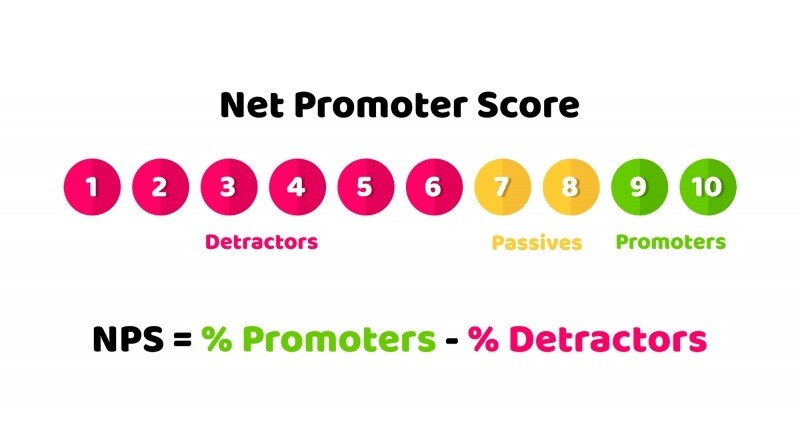
Image via BowNow
So, what makes it one of the important subscription business metrics?
A high NPS indicates that your customers are satisfied and willing to recommend your business to others. This often reflects strong product–market fit, effective customer service, and churn risk.
Conversely, a low NPS signals that improvements may be needed in your product, customer support, or overall service experience.
Also Read:
|
Key Takeaways: 9 Crucial Subscription Business Metrics
|
FAQ
1. What are subscription business metrics?
Subscription business metrics are KPIs used to track the performance of subscription-based companies. They help businesses measure recurring revenue, customer loyalty, retention, and profitability.
Common subscription business metrics include MRR, ARR, churn rate, CAC, and CLV. These insights help SaaS teams make better operational and financial decisions.
2. How do you measure the performance of a subscription business?
You can track key subscription business metrics to measure your business performance. Some important subscription business metrics to consider include:
- Monthly Recurring Revenue (MRR)
- Annual Recurring Revenue (ARR)
- Contracted Monthly Recurring Revenue (CMRR)
- Churn Rate
- Net Revenue Retention (NRR)
- Average Revenue Per Account (ARPA)
- Customer Acquisition Cost (CAC)
- Customer Lifetime Value (CLV)
- Net Promoter Score
Using a subscription management solution like Younium can simplify the process of tracking these metrics. Younium helps you track key subscription metrics and provides detailed reports that deliver insights into business performance, churn, and revenue trends.
3. How do you calculate average subscription revenue?
You can calculate subscription revenue on a monthly, annual, or per-account basis. For subscription businesses, measuring recurring revenue (monthly or annual) is more meaningful than looking only at total revenue for a given period.
To calculate average subscription revenue, multiply the number of subscribers by the average revenue per subscriber or account.
4. How do you evaluate a subscription business model?
A subscription business model can be evaluated based on:
- The revenue generated
- Clients retained
- Clients acquired
- Subscriptions lost
The subscription business metrics discussed in this post help provide a clear, data-driven view of overall performance and sustainability.
5. What is the most important SaaS metric?
The most important subscription business metric depends on your business model and your role within the organization.
A company’s North Star metric is typically its most important metric, as it reflects long-term success. A North Star metric tracks value creation by measuring revenue conversion, customer impact, and overall business progress.
6. How does Younium work as an insights and reporting tool for subscription business metrics?
Younium serves as a centralized insights and reporting platform for subscription businesses. It automatically collects data from billing, CRM, and ERP systems, ensuring a single source of truth for all subscription business metrics.
Through configurable dashboards and AI-powered analytics, Younium helps finance and operations teams monitor key KPIs like MRR, ARR, churn, and customer lifetime value in real time.
It also enables forecasting, anomaly detection, and performance tracking across entities, products, and regions — giving teams actionable insights instead of static reports.
In short, Younium turns raw subscription data into decision-ready intelligence, helping SaaS companies optimize growth, reduce revenue leakage, and stay audit-ready at all times.
7. What is Younium?
Younium is a subscription management and revenue operations platform built for complex B2B SaaS businesses. It automates billing, revenue recognition, and reporting while providing advanced analytics to manage the full subscription lifecycle.
Younium integrates seamlessly with leading ERP, CRM, and payment systems, offering a scalable and compliant foundation for subscription businesses that operate across multiple markets and currencies.
8. What are the best SaaS reporting platforms?
The best SaaS reporting platforms help businesses centralize data, automate financial reporting, and visualize subscription performance in real time. Some of the most capable options include:
- Younium – A complete subscription management and reporting platform designed for B2B SaaS businesses, offering deep integration with finance systems, AI-powered insights, and compliance automation.
- ChartMogul – Strong in analytics and visual dashboards for recurring revenue and other subscription business metrics.
- Baremetrics – Simple and intuitive reporting for smaller SaaS companies tracking MRR, churn, and LTV.
- ProfitWell (by Paddle) – Good for revenue retention analytics and benchmarking across SaaS businesses.
Each of these tools serves different business needs. Younium stands out for scaling and enterprise SaaS teams that require end-to-end subscription management, compliance, and reporting in a single platform.
Which Subscription Business Metrics Suit You Best?
Of all the subscription business metrics listed above, there are likely a few that best reflect your business’s performance.
Consistently tracking the right subscription business metrics is key to ensuring your business scales sustainably.
With the right subscription software, you can manage billing data, performance metrics, and analytics from a single platform. Having centralized and structured data makes it easier to track subscription business metrics accurately and consistently. You can contact Younium to request a demo if you'd like to explore this approach.
Choose the subscription business metrics that align with your goals and start tracking performance with confidence.