Three Types of Tech Companies. Only One Is Built to Last.
Legacy platforms have inaccessible data.. AI-native startups don't have the depth. Here's why cloud-native SaaS is built to win revenue management.
TL;DR
-
Legacy platforms carry years of architectural debt that makes their data too messy for AI to work with effectively
-
AI-native startups demo well but lack the domain scar tissue that comes from solving real fintech problems at scale
-
Cloud-native platforms, built by finance operators, refined over eight years, have the clean data and battle-tested foundation to make AI genuinely powerful
Blog
I spent last week at SaaStock in Austin, and if you pay attention to the rooms people are gathering in, the conversations happening at the espresso bar, and the pitches being thrown around at every after-hours event, something pretty obvious starts to take shape.
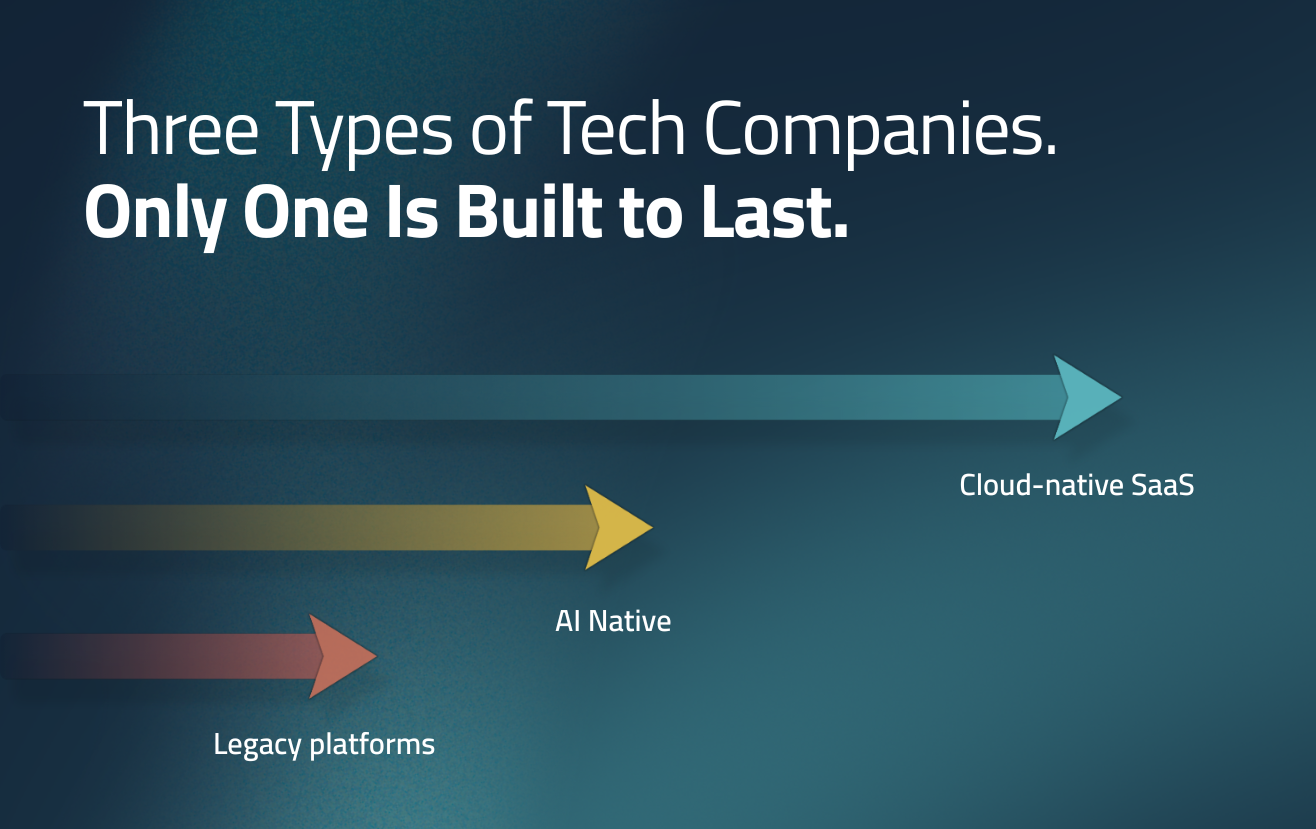
There are three kinds of tech companies in our landscape right now. And only one of them is built to win the next decade.
-
Type one: the legacy systems. These are the platforms that started on-prem, grudgingly graduated to cloud, and have been patching their way forward ever since. They run a lot of mission-critical workflows. They also carry a lot of baggage.
-
Type two: the cloud-native SaaS crowd. This is where Younium lives. Born in the cloud. Open APIs from day one. Built in the era where integration was the expectation, not the exception.
-
Type three: the AI-native newcomers. The fresh crop of companies founded in the last 18 months with AI as the core, not the layer. They’re loud, they demo well, and they’re moving fast.
Every one of these categories is trying to graduate into the next version of itself. One that’s still relevant. Still viable. Still worth buying. Still built for another 20 or 30 years of use. Here’s what became really clear to me at SaaStock. Especially for companies operating in finance, rev rec, billing, or any space that requires massive amounts of technical domain knowledge to even build a foundation, the cloud-native SaaS players who have been grinding for years should be able to pull away from the rest of the pack over the next couple of years. Let me tell you why.
The legacy problem
Every one of these companies is trying to bolt AI onto what they already have. That sounds good on paper. The issue for legacy systems is that AI can only work as well as the data it’s trained on. And legacy data, buried in architectures that were never designed for open access, is rarely in shape to be useful. You can’t retrofit a foundation. You can only patch around it. Finance leaders who have suffered through a NetSuite implementation without the right expertise already know what I’m talking about. Wrong tools plus wrong foundation equals a false sense of security, and an even more expensive migration later.
The AI-native problem
These are the flashiest companies in the space right now. Version one looks amazing. The demos are slick. But here’s the thing nobody wants to say out loud. A version-one platform in fintech is not the same thing as a version-fifty platform that has been battle-tested by thousands of finance teams through every weird contract amendment, mid-contract modification, multi-element bundle, and ASC 606 edge case you can imagine.
Fintech is not vibe-codable. I’m sorry, it just isn’t.
If you don’t know what it feels like to watch an ARR roll forward that doesn’t tie, or a Bookings ≠ Billings ≠ Revenue variance that shows up the day before a board meeting, you’re not going to build a tool that solves it. You’re going to build a tool that solves the version of the problem you imagined from reading about it on the internet.
Tribal knowledge is the moat. And AI-native companies, unless they were founded by operators with real scar tissue, don’t have it yet. That doesn’t mean they won’t get there. It means they have a mountain to climb that older teams have already climbed.
The cloud-native advantage
This is where Younium sits. And this is where I think the real winners of the next decade are going to come from. We have close to eight years of battle-tested platform under the hood. It was built by finance people, for finance people, based on the daily reality of running revenue operations at scale. Millions of transactions have run through our system. Thousands of hours of direct customer feedback have driven the roadmap. Our team’s sole focus for the last eight years has been building the best possible experience for B2B SaaS and AI-native companies trying to manage quote-to-cash, rev rec, and the contract-to-cash gap without living in a spreadsheet.
That foundation is the thing AI cannot reverse-engineer by scraping the internet.
Now layer AI on top of that foundation. That’s the real play.
AI is extraordinary at what it’s extraordinary at. Crunching numbers. Spotting patterns in transaction data. Speeding up analysis that used to live in a VLOOKUP nightmare at the end of every month. When you give AI access to CFO-grade data that has been cleaned, structured, and validated by a platform built specifically for this job, you get something legacy platforms and AI-native startups cannot touch.
The legacy players cannot give AI clean enough data. The AI-native players don’t have enough data, or enough battle-tested functionality, to give AI a real foundation to work from. The cloud-native crowd that built their platform right, kept it open, and has real operators on the team? That’s who’s about to pull away.
Where this lands
When the dust settles on the first generation of flashy fintech AI launches, and the legacy vendors finish their third attempt at a “modern” rewrite, I’m confident about where Younium stands. Eight years of finance-first engineering.
Millions of transactions of real-world feedback. A team built around this specific problem. And a foundation ready to be superpowered by AI rather than rebuilt because of it.
There are a lot of ways to get revenue management wrong. There are very few platforms that have already gotten the hard parts right and are now positioned to make them ten times better. That’s the race we’re in.
And I’m confident that when the dust settles, Younium will continue to stand tall as one of the best, if not the best, options to manage revenue and finance for scaling businesses worldwide.